
The Strangest Regional Restrictions That We Found on the Internet

If, like me, you’ve ever gone abroad and realized that a Netflix show you saved to binge in the evenings wasn’t available in the country you’re in, you’ve become the victim of the mildest form of a much larger problem – geo-restrictions.
As the name implies, these are measures that websites, services, and apps use to limit or deny access based on your geographic location. They’ll check your billing info and compare that to your IP address and other location markers. If these don’t check out, restrictive measures kick in.
This makes sense most of the time. A distributor might not have secured the rights for a show, or a service simply doesn’t operate in another part of the world. Since these are mundane and easily explained away, I set out to find cases where the weirdness is taken to extremes.
Apart from how entertaining the absurdity can be, my aim was also to draw attention to the greater geo-restriction problem and its far-reaching impact on how we use the internet. Take a look at the strangest restrictions I’ve come across, find out why they happen, and learn how 1Browser can help you navigate some of them.
The Strange Regional Restrictions in Effect Today
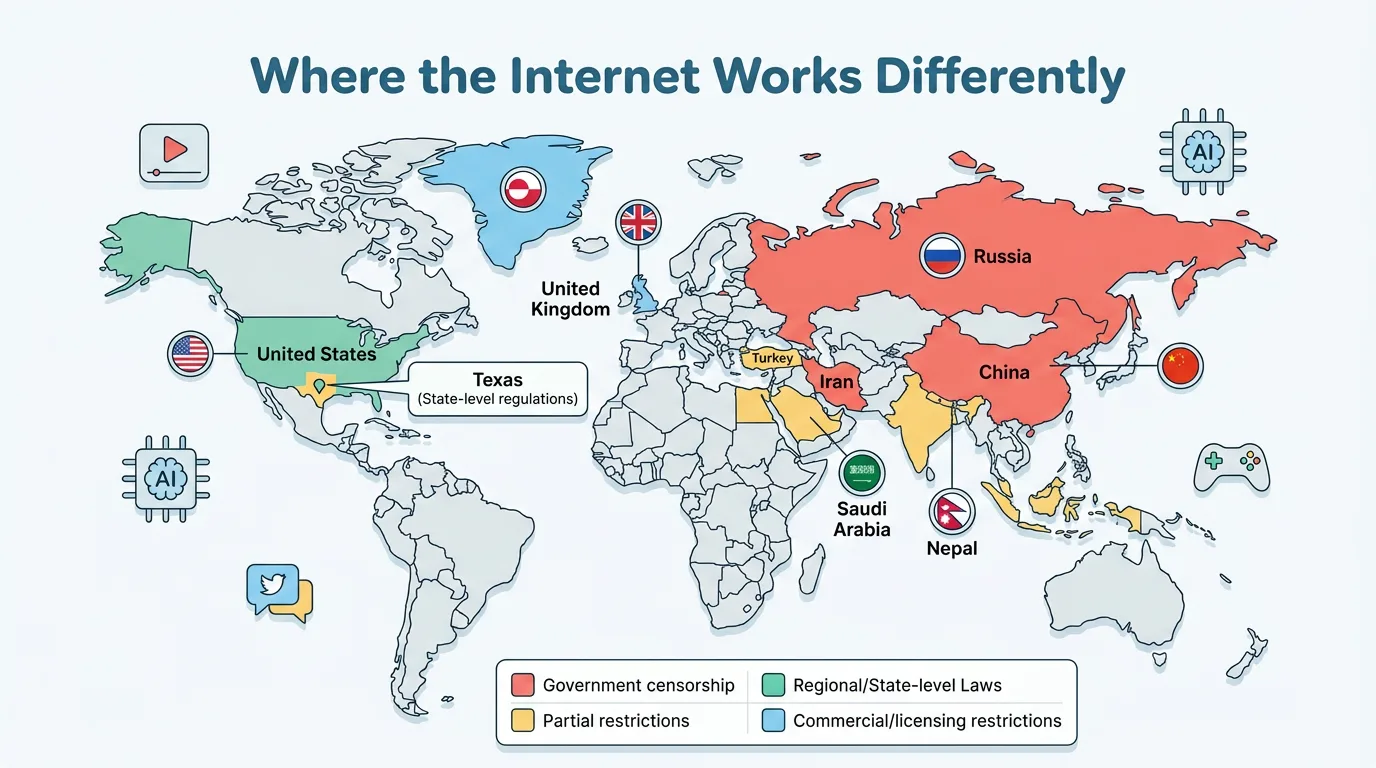
Before actually doing the research, I expected that most examples would follow a predictive pattern. It seemed likely that they would either be a result of local censorship laws or licensing restrictions. While some fit the bill, others left me scratching my head. These are the ten stand-outs.
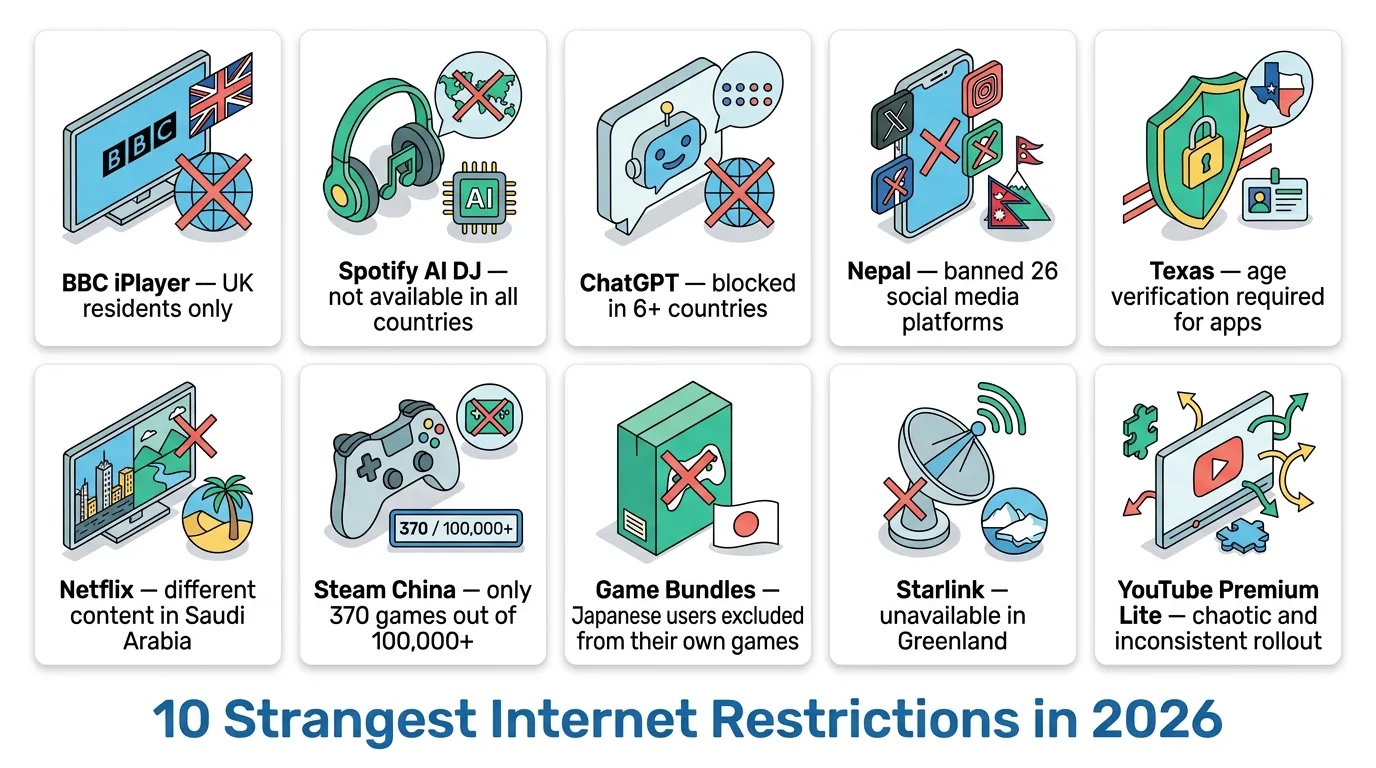
1. BBC’s iPlayer
Let’s start with my favorite example that single-handedly explains why someone might resort to VPNs and proxies to get around bizarre restrictions. The BBC lets people in the UK access its streaming service to watch shows live or catch up with recently missed ones for free. The catch? You have to physically be in the UK to access the player, or you’ll be turned away.
I find it amusing and annoying that someone from England who goes on vacation to Spain can’t keep up with their favorite shows just because they left the country. They’re still paying for their UK TV license but are denied access to its most useful digital feature.
2. Spotify’s AI DJ
While it launched back in 2023, the AI DJ feature had a gradual rollout and still isn’t available everywhere. The strange thing about this particular case is that all the prerequisites seem to be there. You can pay for Premium in every country where Spotify is available. Licensing and copyright agreements for each locally available song are sorted out as well.
Rolling the DJ out was harder than anticipated. Localization is hard work and needs to account for cultural nuances, even for existing languages. Spotify also has to make sure that the DJ’s algorithm only has access to locally licensed content to avoid legal troubles, hefty fees, and unwanted geo-blocking.
3. ChatGPT and other popular LLM unavailability
It’s not surprising that Russia and China would ban access to US-controlled AI services. However, OpenAI also decided not to launch in Cuba, Iran, and Syria. Since these countries are under US sanctions, compliance would be difficult or impossible.
Afghanistan, Belarus, and Eritrea are in their own special tier. This one is the most interesting to me because there’s no single compelling reason for ChatGPT’s unavailability there. Compliance obligations and underdeveloped digital payment infrastructures are given as possible reasons, but nothing is technically stopping ChatGPT, or Gemini in the case of Afghanistan and Belarus, from operating there.
4. Nepal’s administrative social media bans
One of the most creative pretexts for nationwide geo-blocking comes from Nepal. The country’s leadership banned 26 social media sites in 2025, supposedly due to administrative rigor. They argued that these companies didn’t appoint local reps and were disregarding registration and taxation laws.
This did not go over well. The massive protests the ban triggered eventually led to a regime change, and the bans were lifted.
5. The Texas App Store Accountability Act
All the examples I discussed so far fall under country restrictions. It’s highly unusual for one set of rules to apply to just part of a country, but that’s currently the case for Texas. Due to the state’s App Store Accountability Act, users have to provide age verification or obtain parental consent if they’re underage and want to download age-restricted apps.
Texas is setting a noteworthy precedent that could point to a future where account requirements and content restrictions depend on which side of a state border you’re on. While the law means to protect kids, the fact that similar versions in Utah and California are being contested in court makes it a controversial solution.
6. Culturally-based Netflix Censorship
This is an example of how restrictions can be subtle instead of all-encompassing.
Rather than prevent its operation, Saudi Arabia and other Gulf countries influence Netflix’s local catalog. They’ve been known to deny distribution rights for movies and shows that either prominently feature LGBTQ+ themes or criticize the royal family. The prohibition might even apply to a single episode, forcing invested watchers to fill in plot gaps.
7. China’s stripped-down Steam
While the most popular PC gaming platform is available in China, gamers from other parts of the world would scarcely recognize it. Thanks to the Great Firewall, it’s a closed-off system with serious restrictions.
It’s missing the Community Hub, meaning users don’t have access to discussions, reviews, and easy modding options. Whereas elsewhere people can play more than 100,000 games, the Chinese Steam marketplace only offers around 370 titles with official local licenses. Lastly, users can’t search for games using adult or LGBTQ+ tags since these violate local laws.
8. Super-specific game key and bundle restrictions
Bundle websites are a popular means of legally buying PC games cheaply. It’s common for them to restrict games to certain regions due to differences in pricing or licensing issues. However, the reasons are sometimes stranger. Germany used to censor themes and symbols connected to its Nazi past, so you couldn’t activate international versions of affected game keys.
More recently, there were cases where Japanese publishers chose to exclude their games to protect local market prices. So, someone in Korea or the Netherlands can buy a bundle and get a heavily-discounted JRPG as part of it, while a Japanese person only gets the rest. To add insult to injury, the bundles usually cost the same and have no substitutes!
9. Starlink’s absence in Greenland
Coming across this made me do a double-take. You’d think that a territory as huge, sparsely populated, and hard to build infrastructure in would jump at the chance to adopt satellite internet. The satellites already pass overhead every day.
Here, the reasons for the restrictions are legal rather than practical. Starlink has to undergo regulatory approval and reach agreements with local authorities to have a chance at success. Danish protectiveness of its state-owned telecom provider isn’t helping either, especially since turning it into a true competitor by rolling out its own satellite network is improbable.
10. YouTube Premium Lite
I can’t find better words than “a hot mess” to describe YouTube’s handling of its cheaper Premium option. Aside from not being entirely ad-free, Premium Lite is also noteworthy for a messy launch and baffling expansion strategy.
A pilot version launched in several European countries in 2021 but was cancelled two years later. YouTube then revived the tier across 60 countries in 2025 without fanfare. Ireland, Portugal, and a handful of other countries that took part in the pilot were NOT included and still don’t have access! Neither does Indonesia, a country with 140 million users.
I could find plausible explanations or provide an educated guess for the reasons behind the geo-restrictions for every other example. However, only the people at YouTube are privy to the logic behind this one.
Why Do Regional Restrictions Happen?
Keep in mind that the above are outliers and niche examples by definition. Based only on them, one might conclude that restrictions happen randomly and on a whim. As I consulted more sources and researched the matter more deeply, several distinct patterns started to emerge.
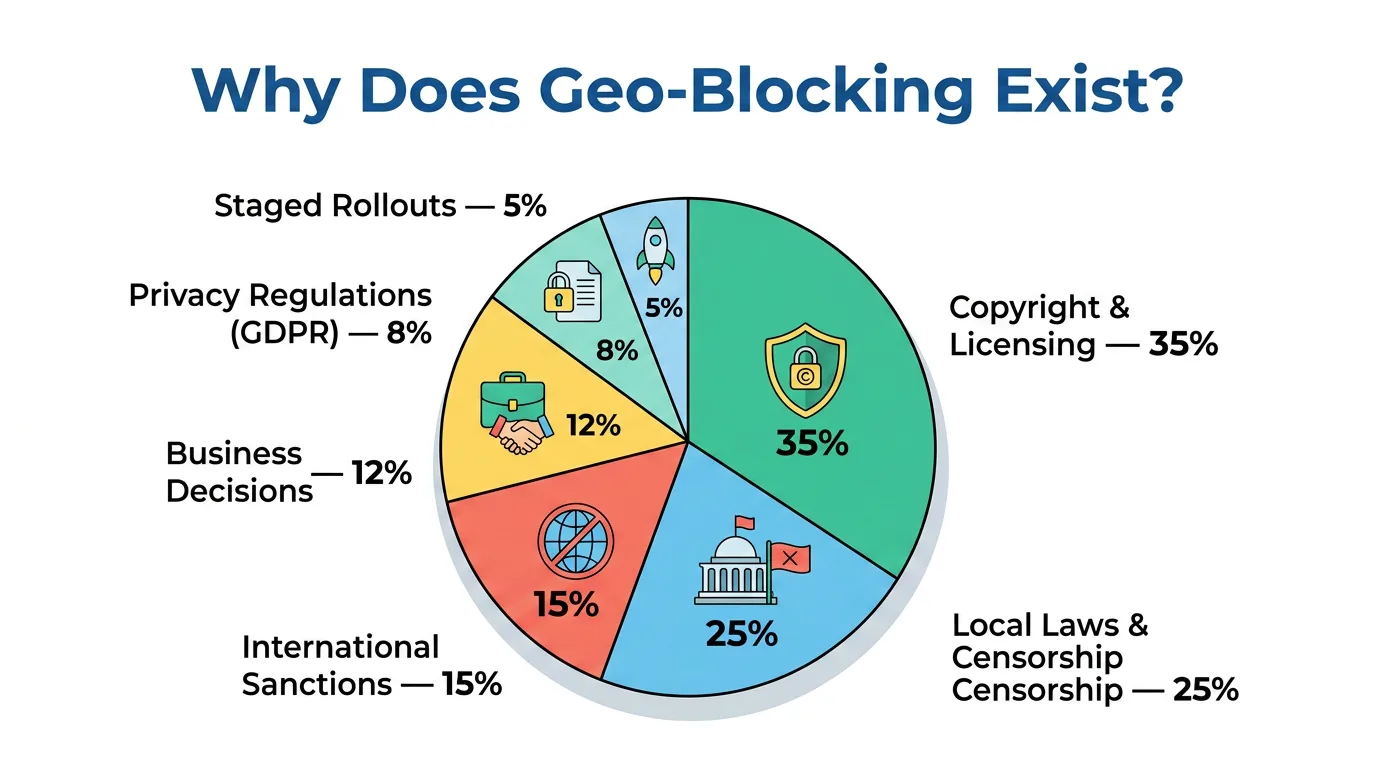
Copyright and licensing
I’ve found that this is the most common and generally the most harmless restriction type. Shows, sports broadcasts, music, etc., are most often offered through online services by region. Sometimes, providers even need to negotiate on a per-country basis. You and an online friend might pay for the same HBO subscription yet not have access to the same catalogs due to copyright differences.
Local laws
Restrictions are also the result of local legal compliance. As per my Texas, Saudi, and China examples, being allowed to operate in a country or region hinges on respecting local laws and cultural customs.
Privacy regulations
It’s important to distinguish country-specific laws from the growing consciousness and legislation surrounding privacy and information handling. Laws like the GDPR might object to AI features like personalization or data collection if these are too invasive. While the services themselves work perfectly, they may roll out later or come with fewer features to stay compliant.
International sanctions
As is the case with ChatGPT and a handful of countries, businesses sometimes can’t enter markets hit by sanctions. Or, they might find that creating country-specific versions of their services isn’t worth the trouble.
Taxation
Local taxation laws may also be too convoluted or unfavorable. For example, many online stores have entered the Brazilian market late or simply don’t bother because state-level sales tax is a nightmare to deal with. Companies might even need to register locally in a country before they can operate, which is particularly off-putting for digital-first businesses.
Business decisions
Offering a different experience sometimes just makes good business sense. It can even be good for the little guy, like Netflix’s entry-level subscriptions being ad-free in countries where implementation would create more pushback than it’s worth.
Staged rollouts
Unless you handle it like YouTube, it makes good sense to make a new feature or product available in select markets first. This lets companies gauge user satisfaction, squash bugs, and offer a better product as a result. While the restrictions are real, they’re only temporary.
The Impact of Internet Restrictions on User Experience
The more I consider these various restrictions, the clearer it becomes how insidious they are. None of them outright prevent you from using the internet. Rather, they create an annoying, fragmented user experience where access depends on incidentals like where you’re located and if you’re willing to pay for better service.
The inconsistencies can affect everyone to some degree. Your favorite HBO show may become unavailable while you’re on vacation, or you might lose access to thousands of apps due to a single law change. Companies not explaining why this happens most of the time definitely isn’t helping.
But entertainment is only the common denominator. Students, professionals, travelers, and creatives may all suffer greater consequences.
- A student without AI access is losing out on individualized teaching needed to master a subject better.
- Digital nomads may have to provide extra verification when accessing their banking apps from more restrictive countries.
- Marketing professionals might not be able to fully utilize their tools if these are restricted in a market.
- Content creators might find themselves making videos for new features that many of their fans can’t use yet.
One can argue that most common restrictions are there for legitimate legal or commercial reasons. At the same time, average users’ perceptions of the internet are shifting. Where it was once universal, some might now see the internet as more localized and challenging to navigate. In an environment like this, it comes as no surprise that people resort to VPNs and other circumvention methods.
How Can 1Browser Help?
If there’s one thing that kept popping up for me during research, it’s how tricky getting around most of these outliers is. There’s little individuals or businesses can do other than wait until sanctions disappear and laws change. While you can bypass streaming restrictions by manipulating your location data, you risk breaking the ToS and having your accounts disabled.
That said, many restrictions are the result of hair-trigger security measures that punish or make legitimate internet activity harder. This is where tools like 1Browser come in.
Being an anti-detect and built-in proxy browser, 1Browser excels at creating and maintaining isolated user environments. It lets you run many profiles at the same time, yet each has a separate identity. This extends beyond accounts – each profile’s cookie settings, browser and hardware information, and IP address are its own.
Coupled with a reliable proxy from Floppydata, this helps you make the internet less unpredictable. You can:
- See different ads, pricing, or competitor information based on local search engine results
- Monitor how your product and feature rollouts are proceeding in other parts of the world
- Test localized website features like translations, whether VAT is calculated correctly, etc.
- Manage multiple worldwide clients from a single browser and internet connection
- Seamlessly switch between self-contained workspaces
- Test workflows by experiencing them like fresh users do
Conclusion
As digging through announcements, legal updates, and plenty of forum threads in search of the oddballs made clear to me, the strangest geo-restriction cases aren’t the ones to pop up in your news feed. At the same time, they’re symptoms of a larger trend.
I don’t think we’ll get rid of such restrictions any time soon. If anything, the evolution of AI on the one hand and privacy consciousness on the other will likely make them even more common. Understanding which restrictions are temporary, which are legitimate, and what tools you can use to mitigate some of them will only become more important.