
Where Are the Most Lenient VPN and Proxy Laws?

In most countries, using VPNs and proxies to improve personal privacy or secure internet traffic is a non-issue. However, some countries see these same tools as troublesome or dangerous, with corresponding restrictions or even outright bans.
In this comprehensive guide, we highlight progressive countries with the most lenient VPN and proxy laws. We also examine jurisdictions that are far less permissive and explain how tools like 1Browser and Floppydata help users affected by them thrive without running afoul of the law.
Evaluation Criteria
Just focusing on VPN and proxy legality doesn’t cover the whole story and isn’t enough for a nuanced ranking. For example, a country’s legal framework might suggest that citizens can use such tools freely, but there’s surveillance in place that means their privacy while doing so is limited.
This is the comprehensive set of criteria we used when coming up with the ranking:
- VPN and proxy legal status – Are VPNs and proxies legal to begin with? This is the fundamental question and most logical starting point. There are several levels of legality at play, ranging from fully legal and unrestricted to illegal or even functionally impossible to implement since infrastructure is either inadequate or heavily controlled.
- VPN and proxy blocking – The technical, rather than legal, restrictions countries impose on VPN and proxy use. They might block VPN servers, protocols, and websites as well as known proxy IP ranges. Or, countries might compel the likes of Google and Apple to remove VPN and proxy apps from their local store pages.
- Licensing requirements – Whether or not an operator needs a license to operate in a country. They may need to ask for state approval and register with the authorities or be sanctioned by state-owned telecom operators.
- Mandatory logging – Do VPNs and proxies need to keep track of users? If logging is mandatory, providers have to collect and present users’ personal information, IP addresses, connection timestamps, etc., if prompted by the authorities.
- Data retention laws – Similar to logging, but with a broader scope. Pertains to how much internet-related information entities like ISPs, cloud and hosting services, as well as VPN and proxy providers need to retain and for how long.
- State internet control – How much power countries exercise in their jurisdiction over the internet. Covers general monitoring, website blocks, forcing content filtration, whether speech regulation exists, etc.
- Privacy rights – The broader privacy-related legal framework protecting a country’s citizens. Privacy may or may not be a constitutional right. Even if it is, it varies how much personal data companies can collect, how invasive surveillance is, and whether citizens can challenge it.
- Usage penalties – The answer to asking what happens if citizens are caught using VPNs and proxies. Ideally, nothing. When penalties do exist, they range from administrative ones like fines to criminal consequences, up to and including death in the most extreme case.
Where Are the Most Lenient VPN Laws?
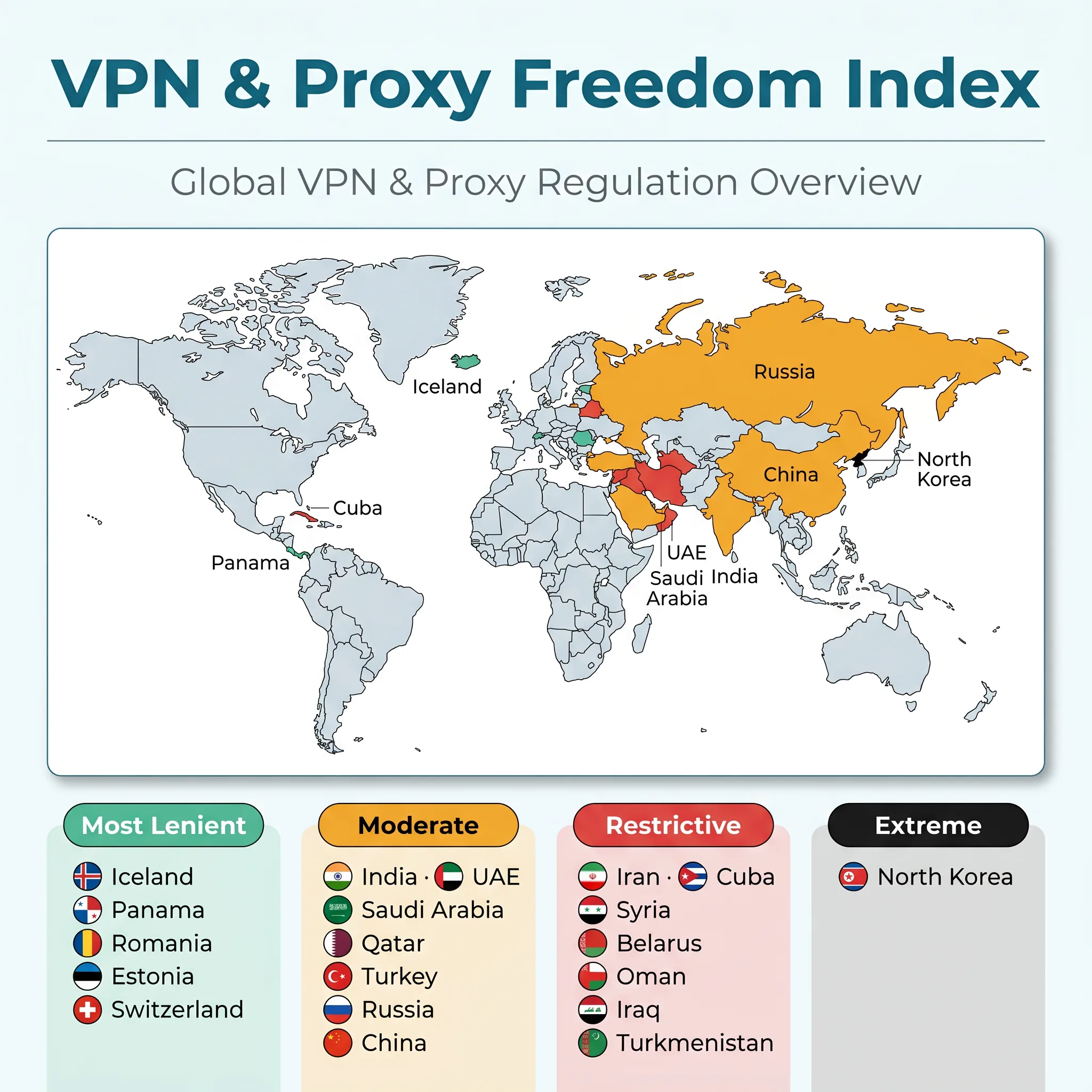
VPN use enjoys a high degree of leniency in most free and open societies. VPNs are a sanctioned internet privacy enhancement tool. Providers don’t need special dispensation to operate them and don’t have to keep logs.
If data retention exists, it’s there to ensure ISPs aid criminal investigations and doesn’t apply to VPNs. Some countries might restrict access to harmful content (child abuse, piracy, etc.,) but don’t penalize or ban VPNs themselves. While citizens have to abide by state laws even when using VPNs, the mere act of using them has no legal consequences.
Positive outliers exist even in this permissive environment. These are countries that go above and beyond in championing their citizens’ privacy rights and creating a digital environment both users and providers can thrive in. Here are the top five.
1. Iceland
Iceland tops our list because several factors come together that make for an exceptional climate of leniency when it comes to VPNs and internet laws in general.
There are very few restrictions, and VPN providers view Iceland as an excellent base of operation. Its government is stable and has never demonstrated hostility toward privacy tools. Iceland is part of the European Economic Area yet isn’t an EU member.
On the one hand, the Icelandic legislature needs to conform to most EU standards. This also includes the GDPR, which gives affected citizens strong privacy protections and the right for data gathered on them to be forgotten. On the other, not being in the EU means Iceland doesn’t have to abide by its foreign policy or take part in military initiatives.
Coupled with a long history of supportive democratic institutions and predictable regulations, this makes Iceland a dependable choice for providers and privacy-conscious users.
- Panama
Panama is another shining example where internet censorship is low and privacy friendliness high. The constitution and Law 81 enacted in 2019 enforce personal data protection comparable to the EU. Formal consent needs to be obtained for personal data to be collected or used.
Whereas Iceland is appealing because of stability and predictability, Panama is a favorite due to low interference. Panama’s government has shown little interest in aggressive VPN regulation. That’s why some of the world’s best-known providers are headquartered there.
Panama isn’t part of any major intelligence sharing alliance. Its data retention laws also only apply to telecom operators. VPN providers are under no obligation to log or provide access to user data.
3. Romania
Readers might know Romania as a country with some of the world’s fastest internet speeds and best-developed infrastructure. While that’s part of the appeal, Romania ranks so high because it’s also fiercely protective of citizens’ privacy rights at the judicial level.
Specifically, Romania’s Constitutional Court rejected laws that would introduce practices like metadata retention and mandatory SIM card registration on three separate occasions. This sends strong signals to privacy advocates that Romania will likely reject similarly invasive laws proposed in the future without disregarding the EU’s legal framework.
In Romania, VPN use is unremarkable and uncontroversial for personal privacy and cybersecurity hygiene. Internet censorship is low, and users don’t need to register to have access to VPNs. Meanwhile, strong infrastructure, including a thriving datacenter market, makes Romania attractive for providers.
4. Estonia
Estonia and Romania have a lot in common when it comes to VPN legality and attitudes toward data privacy. Both are members of the EU. Laws like the GDPR are in effect and genuinely seen as important. Neither attempts to block or ban VPNs, nor any anti-circumvention campaigns, were ever prominent there.
The risks of VPN use for ordinary citizens are practically non-existent. It’s not much different for providers, either. They have to ensure GDPR compliance and meet cybersecurity standards, which aren’t exactly unreasonable demands. Rather than support VPN operations as directly as Romania, Estonia excels at creating a digital and legal environment they’re naturally drawn to.
Estonia has one of the most heavily digitized governments in the world. Secure communication channels and encryption are non-negotiable for storing citizens’ healthcare records or being able to file taxes online. This means the government is more familiar with encryption and other technologies VPNs rely on than most. A lack of hostility toward VPN operators naturally results from this greater understanding.
Finally, Estonia has a successful history of attracting online businesses and tech startups that spans several decades. Unsurprisingly, its legal framework is tech-friendly and stable. VPN companies can operate there with confidence.
5. Switzerland
Switzerland’s centuries-old dedication to neutrality, citizens’ rights, and a business climate that emphasizes clients’ privacy put it in an excellent position to also take the digital privacy initiative. The infrastructure is there, while systematic internet censorship and filtration are not present.
Currently, Switzerland deserves a spot on this list. If anything, its privacy-friendliness and minimal risk for businesses and users are enough to place Switzerland at or near the top. While Switzerland still ranks among the countries with the least strict internet laws, this might soon change.
Specifically, amendments were proposed to the way telecommunications are monitored. Present rules only apply to large telecom operators. Were the amendments to pass, VPN companies might be reclassified as service providers. They’d also potentially need to store and hand over user data.
This would turn Switzerland from a privacy-conscious and permissive jurisdiction into one that remains functional but introduces regulations privacy-conscious users may not be comfortable with.
While they may be rejected, the fact that proposals like this are even on the table make VPN providers pause. Not being able to claim a no-logs policy in Switzerland anymore is understandably distressing since it undermines foundational VPN privacy promises. Some providers that were previously headquartered there have already moved as a precaution.
Honorable mentions
The five countries above are the best of the best in a highly competitive environment. Many more offer similar freedoms and didn’t make the cut based on nuances.
Low censorship and excellent infrastructure in Norway and the Netherlands put them on par with our picks. However, being part of the Nine and Fourteen Eyes alliances opens up surveillance and privacy concerns.
- Romania’s judicial aggressiveness edged out Finland’s robust but comparatively unremarkable privacy protections.
- Canada and New Zealand generally provide the same freedoms as the above, but their Five Eyes membership gives them less privacy credibility.
Where Are the Most Lenient Proxy Laws?
There are few differences between proxies and VPNs from a legal standpoint in most legislatures. When laws concerning them exist, they focus more on concepts that might be misused, like anonymization and accessing blocked content. VPNs and proxies fall under that same broad scope, especially in countries where regulations are permissive.
VPNs’ greater impact and broader public awareness means proxies often get less scrutiny. Restrictive governments focus on VPNs because they’re used for data encryption and to bypass restrictions or censorship. They tend to concentrate on monitoring and disabling VPN-specific protocols like OpenVPN and WireGuard. Conversely, HTTPS and other proxy types have an easier time blending in with ordinary traffic.
Which Country Has the Least Strict Internet Laws?
There’s no universally accepted ranking of internet law leniency. Even extensive surveys like Freedom House’s Freedom on the Net group countries into categories. Estonia, Finland, Iceland, the Netherlands, and Norway are top tier. None of them criminalize privacy tools, surveil their populations at scale, or use systemic censorship.
If we had to pick just one country out of these five, the win would have to go to Iceland. Its citizens face fewer surveillance pressures than the others’. Also, strong constitutional and civil liberty protections exist to ensure government access to personal communication is constrained and under legal oversight.
Where are VPN and Proxy Restrictions Moderate?
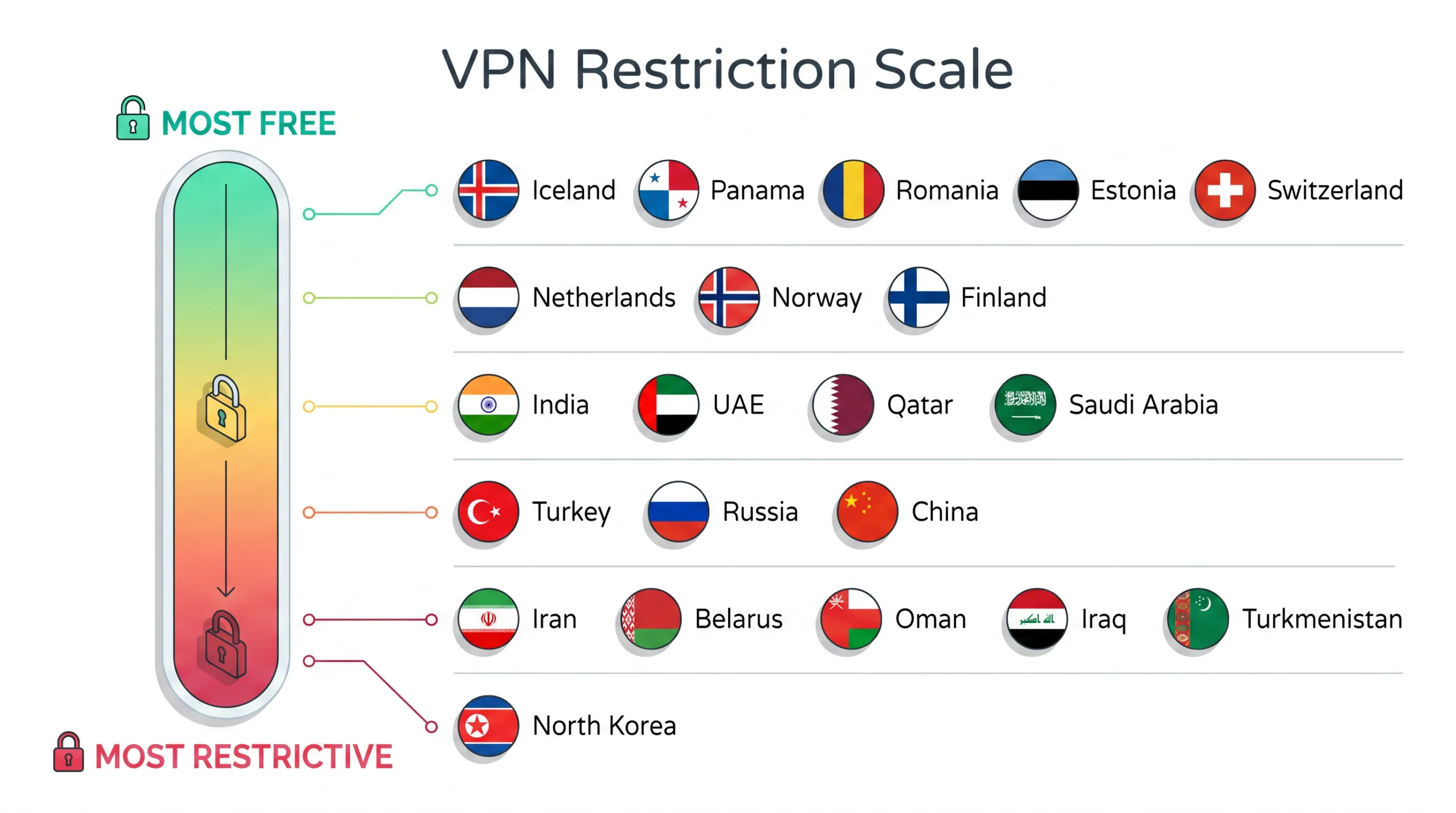
Countries in the moderate tier allow VPNs and proxies in principle, but this comes with caveats. Providers might need to register with the authorities or log users’ actions. Encryption might not be condemned outright, but it can’t be used as a measure to bypass government restrictions and access prohibited content.
How restrictive different countries are varies considerably:
- People have legal access to VPNs in India, but providers have to keep logs.
- The UAE, Saudi Arabia, and Qatar allow VPNs. How someone intends to use them matters. Trying to bypass government censorship or access content that’s considered immoral brings hefty fines. The worst offenders may even face prison.
- Russia and Turkey don’t formally ban VPNs. However, both throttle VPN traffic and may limit or ban providers.
- In China, residents can legally only use VPNs sanctioned by the state. The Great Firewall blocks most outside VPN apps.
Which Countries Impose the Worst Restrictions and Penalties?
The last category thankfully comprises only a handful of countries. Internet and personal freedoms are scarce there as is; VPNs and proxies are seen as threats to the regime and treated as such. Countries in this category routinely block VPN protocols and even internet access outright. Or, they may use harsh cybersecurity laws as justification for prosecuting VPN-using opponents.
- Venezuela is the most “benign” example in this category. The government engages in censorship and may block sites like social media. While VPNs remain legal, there have been threats to penalize their use.
- Iran has outlawed non-state-sanctioned VPNs and heavily restricts internet use during unrest.
- The internet in Cuba and Syria is under total state control and can be turned off during times of unrest. VPN sites and protocols are blocked.
- Oman and Belarus have criminalized all circumvention methods, including VPNs. Criminal charges apply to rule breakers.
- Iraq and Turkmenistan have outlawed VPNs and filter for their use.
- North Korea is the worst offender since it bans all foreign internet tools. Possessing a VPN is already a serious offense punished by imprisonment. If the state decides that a person used a VPN to distribute foreign propaganda or plan seditious activities, they may even be sentenced to death.
Overcoming The Challenges of Operating Across Different Internet Environments
In much of the world, individuals and businesses take permissive internet and privacy tool usage as a given. However, those that operate internationally may find themselves in situations where they have to work from environments with different levels of internet filtering or surveillance.
Users that find themselves in restrictive jurisdiction have to pay close attention to operate in accordance with local laws and regulations. That said, they can still take advantage of select tools to strengthen privacy, connectivity, and continuity.
Ensuring operational stability with Floppydata
Operating internationally means understanding and managing the practical differences various jurisdictions introduce. Proxy providers like Floppydata offer the location-specific access needed to ensure operational consistency.
For example, a company might use Floppydata’s location-specific proxies to test whether ads, language options, and any necessary regulatory disclosures are displayed properly in regions where specific restrictions apply.
Distributed teams are another strong example. Members typically use fixed IPs or addresses from a predefined range to ensure logging into services from a different country doesn’t trigger unnecessary alerts. In that context, proxies come in handy for continuity, not as a circumvention tool.
Whatever the use case, Floppydata’s excellent uptimes, broad selection of proxies by type and location, and reasonable prices provide compelling support.
Creating identity separation with 1Browser
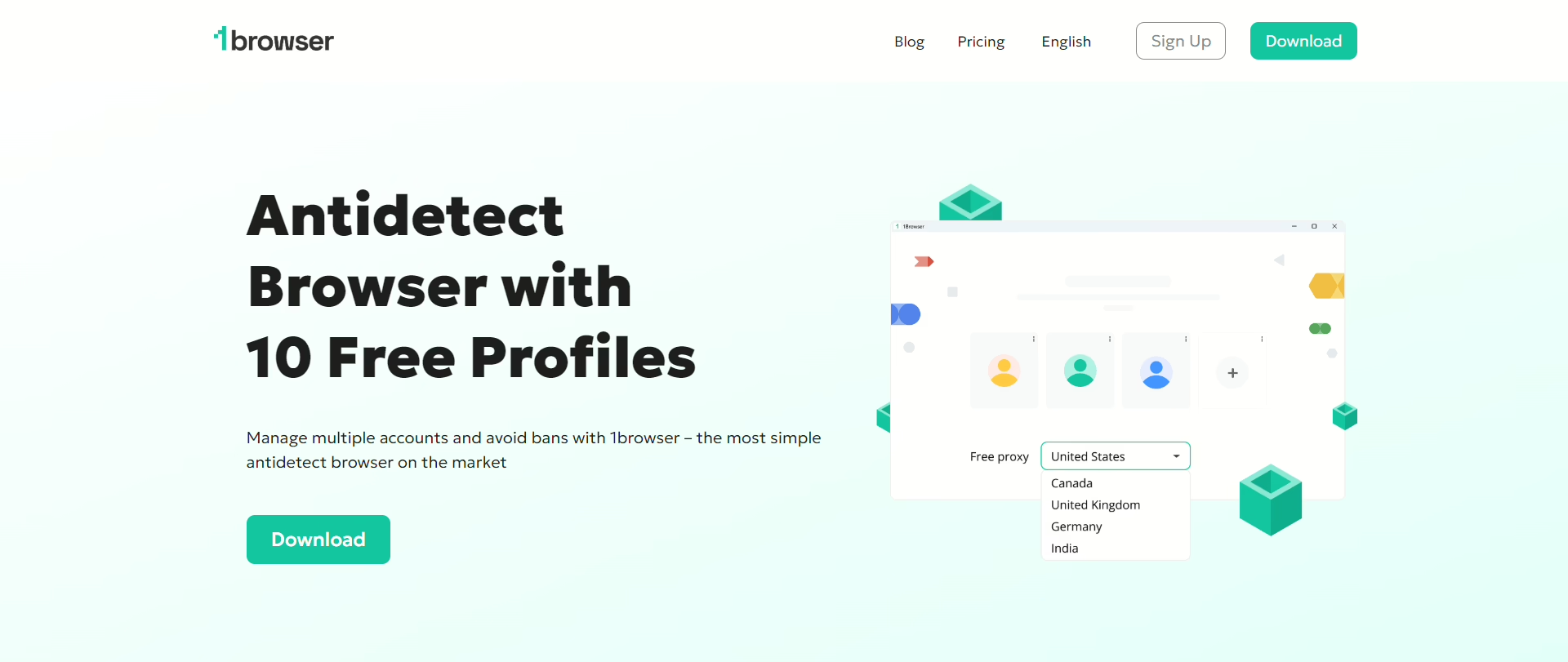
Proxies are indispensable for managing network access. Meanwhile, anti-detect browsers like 1Browser are key for keeping digital identities from bleeding into each other.
1Browser goes beyond IP addresses by providing unique browser environments for different use cases. Each is self-contained, meaning that profiles, proxy associations, device fingerprints, and sessions remain distinct and separate.
Companies might use this to maintain different versions of their website for different markets, including compliance with specific restrictions. Individuals can use 1Browser to switch between their administrative business accounts and personal ones without having to use different browsers or separate devices.
Conclusion
Whether or not a country is VPN friendly never comes down to a single law. Rather, countries that are consistently the most lenient avoid unnecessary regulation and surveillance while promoting personal freedoms and an open internet.
Our ranking may change as governments decide to adopt stronger age and identity verification or amend their data retention policies. But for now, readers can use them as a reliable benchmark for where they can expect the greatest freedoms, as well as for places where 1Browser and Floppydata’s help maintain secure and consistent digital operations.