

Top IPv6 and IPv4 Proxies Compared in 2026

If you’ve recently been shopping around for proxies, you’ve inevitably seen providers boast about their IPv6 pools. Indeed, it’s easy for newbies to be taken in by the higher number and promise of limitless IPs even though IPv4 still has a lot of uses.
My aim for this comparison article was to demystify the differences and compare proxy providers that handle both address types competently. Here’s what you need to know, what features actually matter, and which proxy providers offer more than just marketing fluff.
| Provider | IP pool | Coverage
(countries) |
Uptime | Starting prices | Scamalytics score (Fraud Score) – (US IPs) |
Trials |
| Oxylabs | 175M+ residential
7M+ mobile 45K+ datacenter |
195+ | 99.9% | $6/GB residential
$7.50/GB mobile $0.59/GB datacenter |
9.9 | 5 free datacenter IPs |
| Floppydata | 65M+ total | 195+ | 99.9% | $1/GB residential, datacenter, and mobile | 14 | $1 trial |
| Decodo | 115M+ residential
10M+ mobile 500K+ datacenter |
195+ | 99.9% | $4/GB residential
$7/GB mobile $0.70/GB datacenter |
9 | Free, data capped |
| Bright Data | 400M+ residential
7M+ mobile 1.3M+ datacenter |
195 | 99.9% | $8/GB residential and mobile
$0.60/GB datacenter |
Untested | 7-day free |
| IPRoyal | 32M+ residential
4.5M+ mobile 400K+ datacenter |
195+ | 99.9% | $1.75/GB residential
$10.11/GB mobile $1.35/IP datacenter |
6.5 | Free for business |
| SOAX | 155M+ residential
33M+ mobile 300K+ datacenter |
195 | 99.9% | $3/GB | 9.2 | $1.99 for 450MB, valid for 3 days |
| Infatica | 35M+ residential
1M+ mobile 500K+ datacenter |
195 | 99.9% | $4/GB residential
$18/GB mobile $1/IP datacenter |
10.3 | $4 for 1GB of test traffic |
IPv4 Proxies vs. IPv6 Proxies: What’s the Difference?
Datacenter, residential, and ISP proxies all come in IPv4 and IPv6 formats. IPv4 is the older, 32-bit version of the IP addressing system. It maxes out at around 4.3 billion addresses. A bit over 500 million are reserved, while the rest have already been allocated.
Meanwhile, IPv6 has a 128-bit format with space for 3.4×10³⁸ addresses. Even with the number of unique user and IoT devices connecting to the internet growing exponentially, the IPv6 address pool remains practically endless.
IPv4 proxies remain relevant since websites continue to recognize traffic coming from IPv4 addresses. Only around 31.5% of websites now support IPv6, and that number climbs to 52% for the 1,000 most used websites. Even IPv6-compatible websites use a dual-stack setup to recognize both protocols.
It’s often cheaper to buy more IPv6 proxies, and their addresses are less likely to have already been used for scraping or social media automation. But you’ll need to make sure that the target website can be accessed through an IPv6 address.
Selection criteria
When putting together this list, I focused on the reliability of each provider’s infrastructure for supporting actual proxy workflows. I based the final ranking on six criteria, in order of importance:
Success rate – Performance consistency, timeout rates, frequency of connection errors.
IP reputation – Whether addresses come from actual residential or ISP networks, whether they’re shared or dedicated, associated ASN and subnet reputation.
External fraud risk indicators – Results obtained through extensive IP testing. When expressed in a Scamalytics score, I went with data obtained on US-based IPs since these are scrutinized more than global ones. Lower is better.
IP pool size – Total number of available addresses plus regional address availability and granularity.
Session control – Whether you can set up sticky sessions, rotate proxies yourself, and maintain IPs across workflows.
Speed and stability – Connection speed, throughput, uptime, lag, stability under load.
Value – How much you’re getting for the price
The best IPv6 Proxy Providers
1. Oxylabs
Oxylabs has some of the most robust and dependable proxy infrastructure with excellent global coverage, so it topping the list shouldn’t come as a surprise. You can choose between IPv4 or IPv6 addresses regardless of proxy type, and its supporting ecosystem is geared toward scraping at scale.
Stellar stats cement Oxylabs’ high placement. Proxyway puts its global success rate at 99.93%, while average response times are a respectable 0.6s. With a fraud risk score just shy of 10, it’s also among the most trustworthy operators out there.
Once I set it up, I could use the Scraper API’s Scheduler to automate scraping jobs and results storage. A drawback worth noting is that intense use gets very expensive if you’re not an enterprise.
2. 1Browser
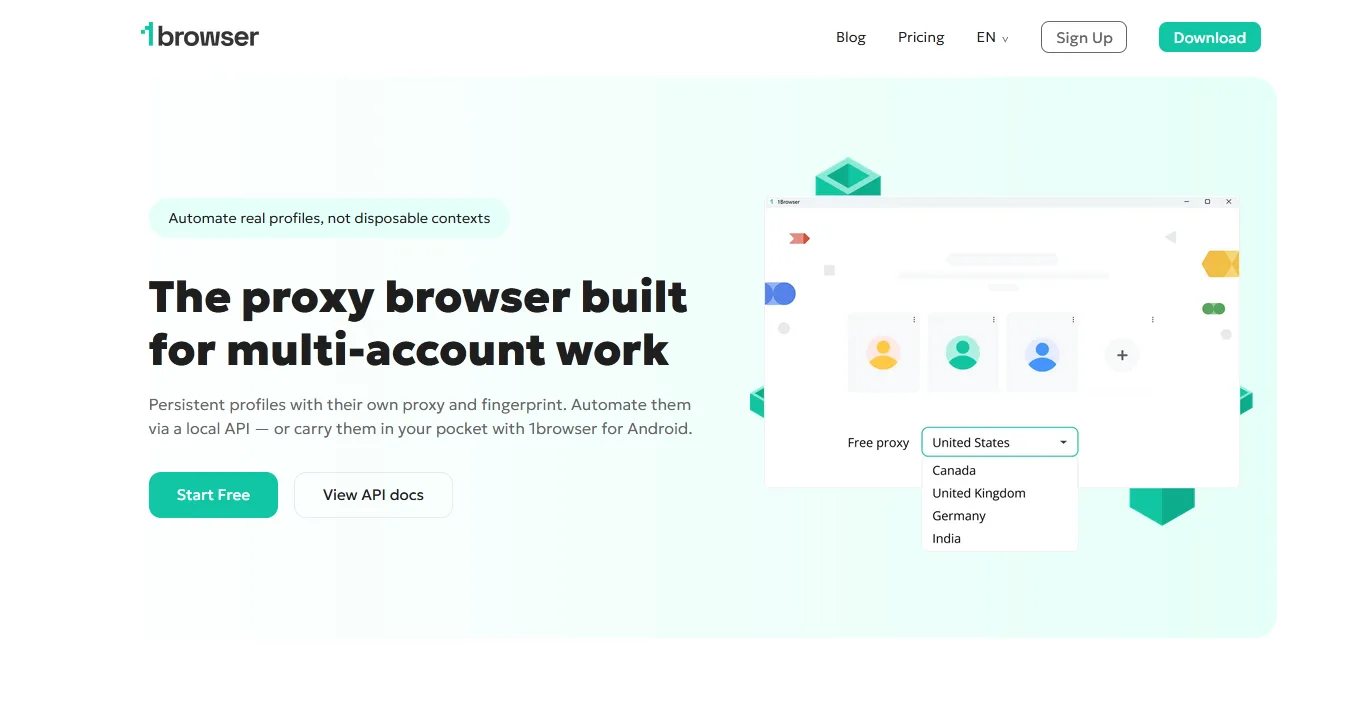
While 1Browser maintains a network of residential, datacenter, and mobile proxies, I included it here due to the additional value it provides for the most complex workflows.
No matter if they’re IPv4 or IPv6, proxy IP addresses alone can’t create self-contained and persistent environments. You’ll need those for multi-accounting, long-term social media account management, or even just operating the same account from multiple devices without having to wrestle with security checks.
1Browser creates persistent and unique environments for each account. These have distinct hardware and software fingerprints as well as IP addresses provided either by built-in or external proxies.
3. Floppydata
My 3rd place pick doesn’t have the biggest proxy pool nor the fanciest scraping infrastructure. However, Floppydata excels at providing fast, clean, and dependable IPs with excellent global coverage at a price that makes it more competitive for average users than the likes of Oxylabs and Bright Data.
I like the ease with which Floppydata lets you switch proxy traffic. You can focus exclusively on residential IPv6 proxies or switch to datacenter and mobile IPs while on the same affordable plan. This makes Floppydata a good fit for content verification, ad testing, and other workflows where infrastructure reliability and diversity trump raw IP volume.
Independent testing also corroborates the excellent reputation of Floppydata’s IPs. ToProxyLab ran 79 IPQS checks, none of which was flagged. They also achieved a Scamalytics score of 14. Scamalytics scores operate on a 1-100 scale, so even though Floppydata’s score is slightly higher than the others, its trustworthiness is still in world-class territory.
4. Decodo
Think of Decodo as Oxylabs for the average user. I particularly like the dashboard you can get to grips with and start doing scraping operations from even if you haven’t worked with proxies before.
You can explicitly request IPv4 when accessing its expansive IP network, making Decodo one of the best IPv4 proxy providers. Its mobile proxies are particularly responsive – Connecting to Amazon or Instagram takes around 2.7 seconds, almost a second faster than Proxyway’s testing average.
5. Bright Data
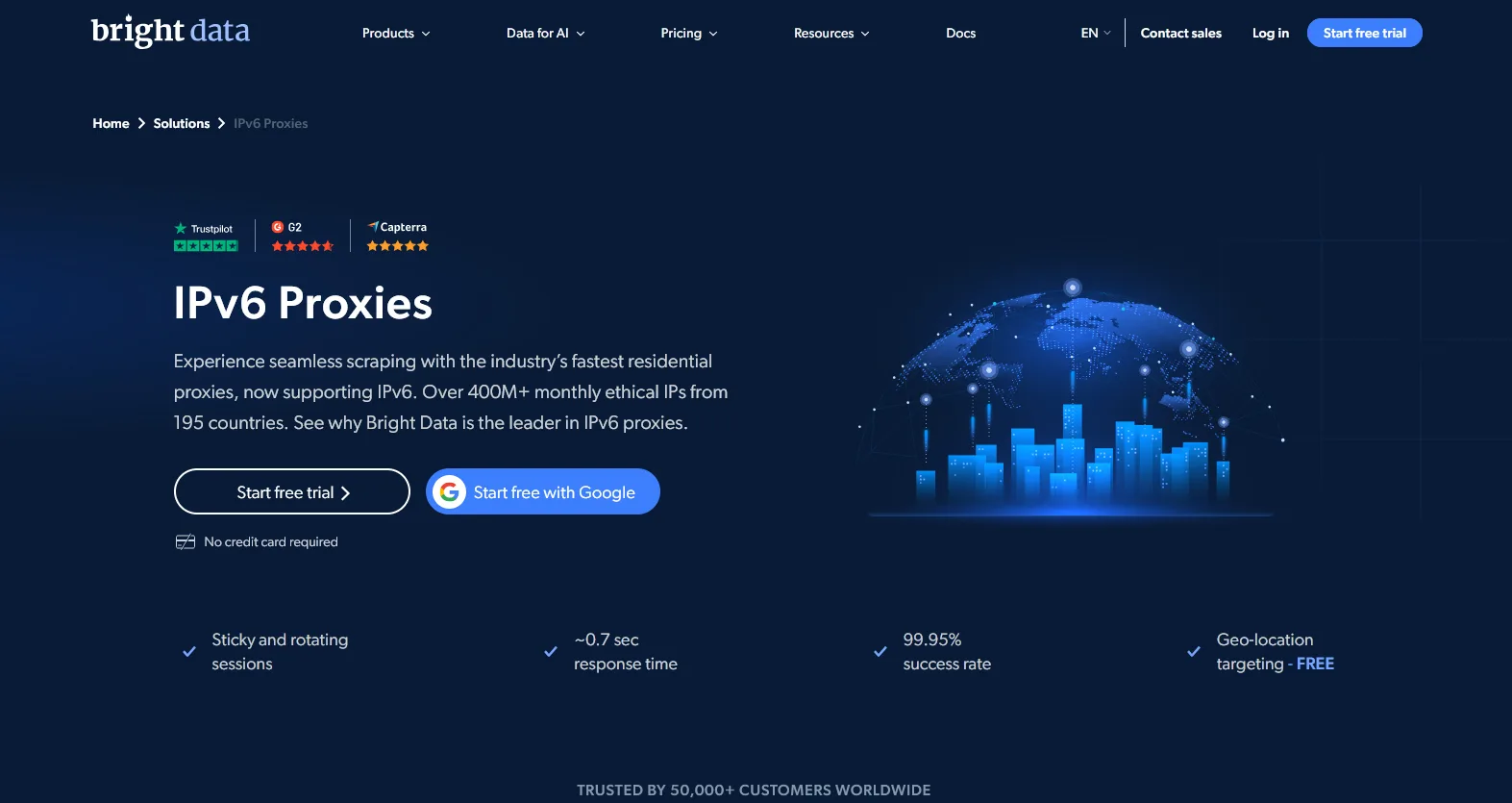
Just getting to use Bright Data can be a hassle due to strict KYC checks, and pricing definitely positions it as an enterprise provider. In return, you’re getting access to the world’s largest residential proxy pool and the ability to switch between IPv6 and IPv4 while your credentials and configuration stay the same.
I found the Web Unlocker especially useful. You send HTTP requests through it, and the Unlocker handles everything from residential or mobile IP selection to CAPTCHA solving. Payment is also per successful request rather than bandwidth.
Proxy pool inconsistency is a thing to note before choosing Bright Data. It has high success rates globally, but a high number of its US-based IPs get identified as proxies. Bright Data also withdrew from recent Proxyway testing, so recent dependable Scamalytics results conducted on a large number of IPs aren’t available.
6. SOAX
I included SOAX due to its versatile proxy pool and strong mobile coverage. SOAX emphasizes that its mobile proxies use IPv4 and IPv6 addresses provided by real mobile devices. Geographic granularity is adequate, and I was most impressed by the number of mobile carriers on offer.
SOAX is only slightly slower and less dependable than Oxylabs. The latest testing clocks its success rate at 99.78% globally, with a 3% drop for EU mobile IPs. At 9.2, the ip detection risk is academically lower than Oxylabs’, too.
MaxIP is particularly useful for workflows relying on unique residential IPs. Instead of cycling through fewer reused nodes, MaxIP draws broadly from SOAX’s residential IP pool. Your requests are less likely to get flagged this way, making high-volume scraping or bulk actions more viable.
7. IPRoyal
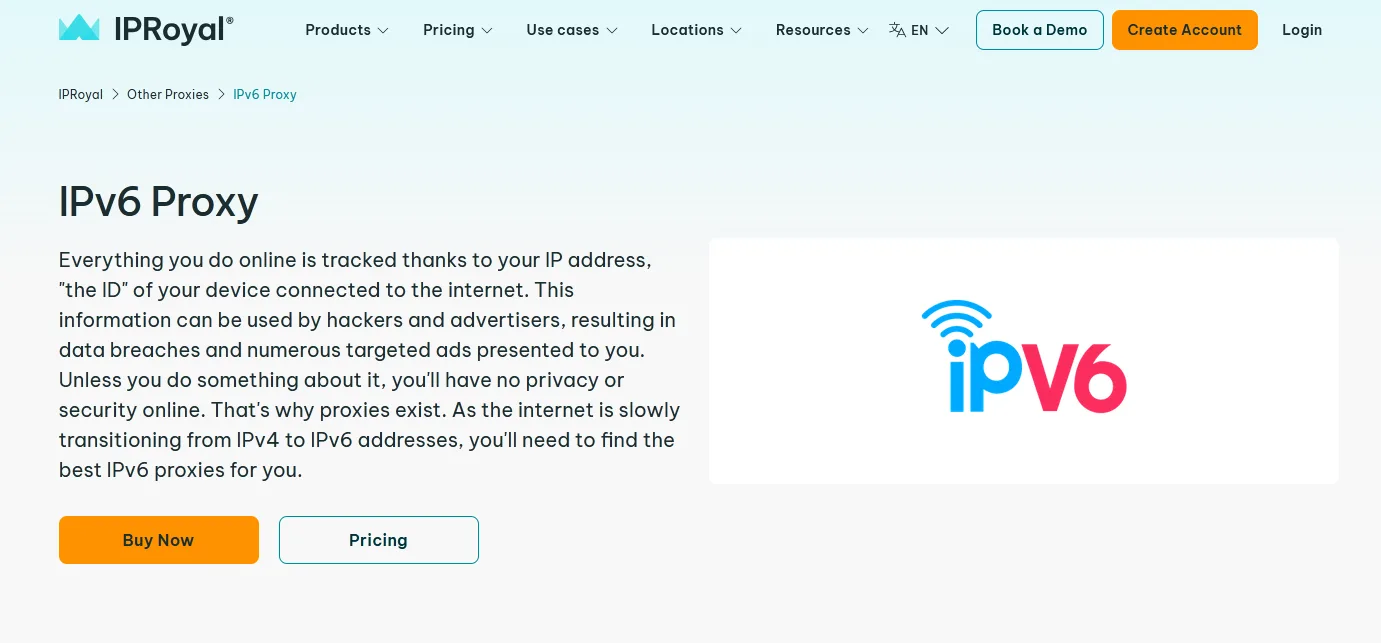
IPRoyal primarily offers IPv4 proxies. It makes up for this with good global coverage and a customer-friendly PAYG model with residential traffic that doesn’t expire. I also found their long sticky sessions useful for warming up new social media accounts. They can last up to 7 days, which is plenty of time to spin up a new account.
I was also pleasantly surprised by how well IPRoyal scored in fraud testing. It beat the likes of SOAX and Oxylabs by three points, displaying commendable IP quality in an already highly competitive gauntlet. Once it starts reliably offering IPV6 proxies, IPRoyal’s ranking on the list will surely improve.
8. Infatica
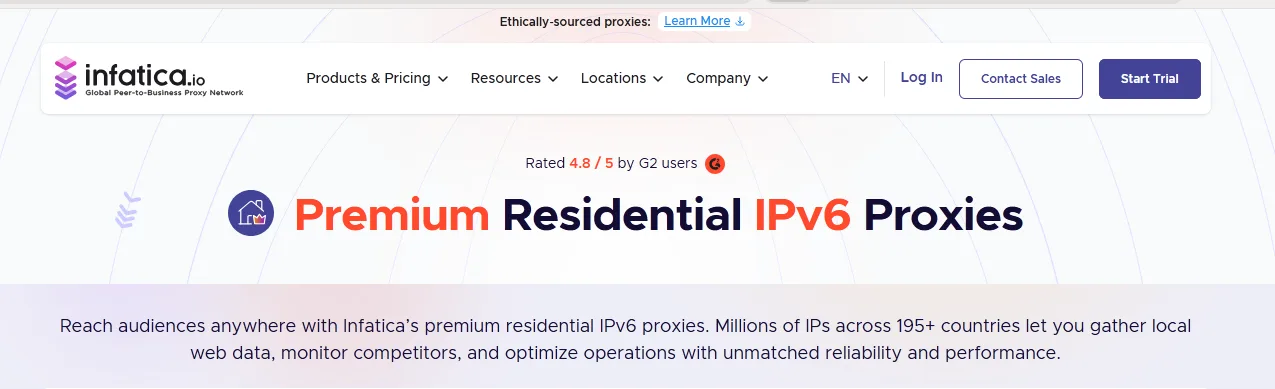
Infatica stands out by offering premium IPv6 residential proxies with more than 500K IPs per plan. It’s also among the stronger mobile options, with strong mobile IP uniqueness and global representation.
It’s only last because I experienced lag when connecting through some regional IPs, and the average response time was noticeably longer than with most other providers. A fraud risk score of 10.3 is outstanding when compared to the slew of proxy providers that didn’t make the cut but unremarkable given the competition here.
Conclusion
While I intentionally aimed to provide a balanced list of providers, the best one depends on your specific use case. You’ll first want to check whether the website you’ll be working with supports IPv6 addresses. From there, you can either go with IPv4 for the broadest compatibility or switch to IPv6 for workflows that take advantage of IP breadth.
IP version is a useful metric, but it’s ultimately a superficial one. Session persistence, residential IP quality, mobile IP coverage, and extra tools that speed up or simplify workflows will make all the difference.