Best Android Cloud Phone Services: Complete Comparison

For the longest time, cloud phones were something hardcore gamers used to keep up with the mobile game grind. The tech and infrastructure have matured to the point that you can dedicate cloud phones to any serious workflow you’d previously need a phone farm to support.
A market of cloud phone services quickly sprang up, and I wasn’t surprised to see that anti-detect providers were among the first to see the benefits. However, I was disappointed that there wasn’t much information other than marketing fluff to go on when making your choice.
This in-depth comparison is my go at creating a resource that will help you understand what cloud phones are, what use cases they’re good for, and which providers are worth looking at.
| Provider | Status | Best fit for | Proxy handling | Pricing model |
| Gologin Cloud Android | Live | General multi-accounting workflows | Built-in residential/mobile proxy management + custom proxies | Monthly subscription |
| MoreLogin | Live | Workflow automation | External | Per-minute usage + monthly device rentals |
| VMOS Cloud | Live | Control over what phones you get | Offered through service in same ecosystem | Per-minute usage + monthly device rentals |
| DuoPlus | Live | Large-scale operations | External | Per-minute usage + weekly and monthly device rentals |
| GeeLark | Live | Social media management | External | Per-minute usage + monthly device rentals |
| RedFinger | Live | Gaming | External, not a priority | Tiered subscriptions |
What Is a Cloud Android Phone?
A cloud Android phone is a virtual smartphone hosted in a cloud environment you control remotely. Some providers use physical phones, but the recent competition boom has mainly been powered by virtual devices running on ARM servers.
The phone behaves just like any other. The difference is that you tap, install apps, or run automations from a web dashboard or app interface. Your actions get sent to the host, which then provides appropriate responses. When you’re done using the phone the state is saved.
This immediately piqued my interest as an excellent way to handle handoffs. You can set up a social media scheduling workflow or testing environment once and just share between team members without having to fiddle with settings every time.
Being cloud-based also means your physical device doesn’t need the kind of beefy specs usually required for Android emulation. I’ve seen a single desktop computer and three monitors replace a wall of phones running social media account warmups.
Use cases
Most cloud phone use cases focus on solving one of two problems. They either tackle not having enough devices or not being able to keep them running all the time.
- Multi-accounting – Each cloud phone is a separate Android environment. This means you can run multiple social media accounts, ecommerce stores, messaging accounts, gaming accounts, etc.
- Automation persistence – The virtual phone is on 24/7, so automations run continuously.
- QA and testing – If a provider lets you choose a specific type of phone, devs can test apps on a wide range of different devices without having to track down and buy them.
- Access continuity – The virtual environment stays the same no matter where you access it from. I frequently switch between a desktop and phone, and this makes Android-related workflows feel seamless.
- Gaming – Keeps games active to collect rewards while keeping your actual phone free to do other things.
Selection Criteria
It’s hard to tell who makes cloud mobile phones that are actually worth your time when all you have to go on is the same marketing. That’s why the first thing I did was come up with tangible criteria that would help make the selection clearer. This is the list.
- Device authenticity – How convincing the devices are overall. Are they physical/ARM-based, or just emulated?
- Account and device isolation – Does each device have a truly separate environment with unique identifiers, storage, network configuration, etc.?
- Device management – How many phones can you make, and how easy it is to manage and synchronize them in bulk.
- Network options – Proxy availability and compatibility along with ease of configuration.
- Configuration options – Ability to choose parameters like Android version, phone type, and hardware
- Performance – Startup times, responsiveness, latency, session stability.
- Pricing – Not just the sticker price but what exactly you’re getting and how intuitive the pricing structure is.
The Best Android Cloud Phone Providers
1. Gologin Cloud Android
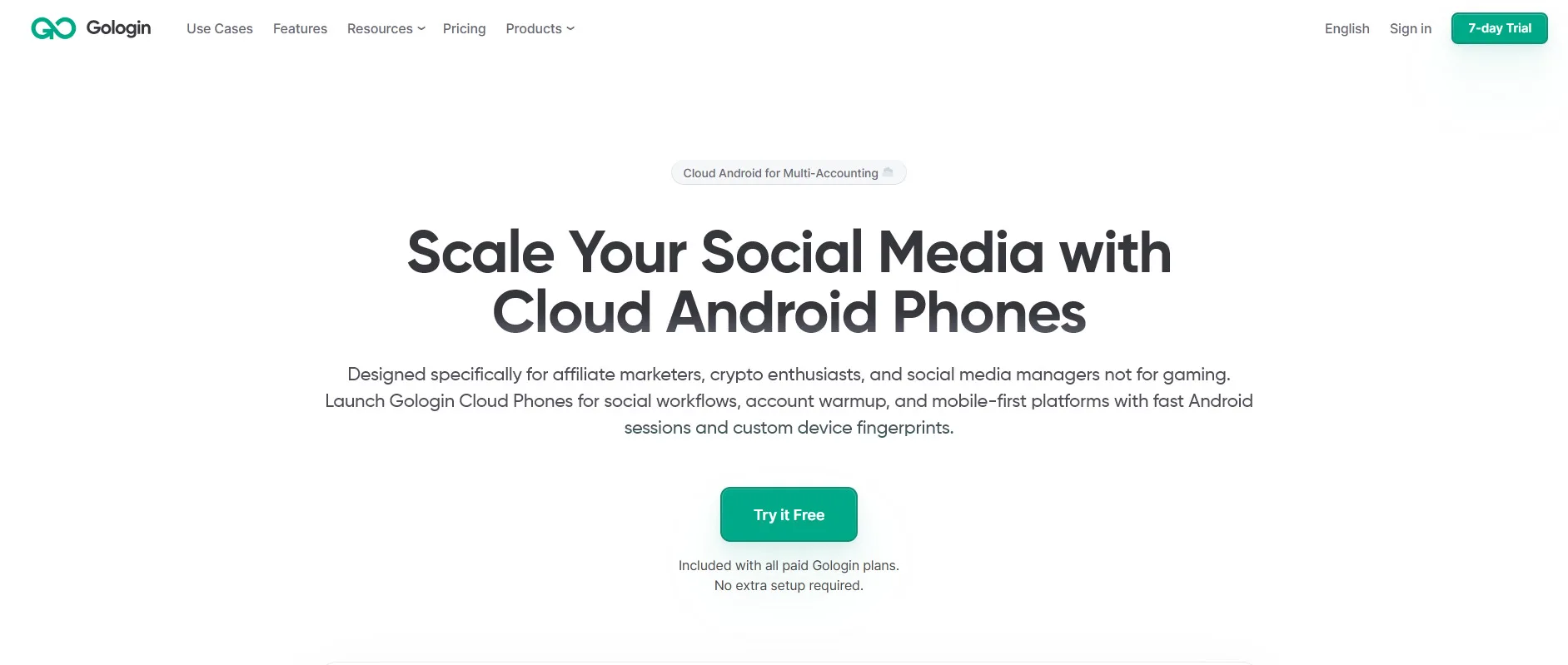
Gologin is a respected anti-detect browser that recently started offering cloud phone services. And, as you can tell by the fact that Gologin tops my list, they did this in a way that will likely shake up the market. Instead of launching and charging for a separate service, Gologin decided to add cloud phones straight into the main app.
I’ve been using Gologin as my main multi-account workflow driver since 2025 and raised an eyebrow when the cloud phone tab popped up a couple of months ago. The surprise grew once I started researching this and saw that cloud phone Android services were now a core part of the Gologin package and covered by my $9 monthly sub.
This might not mean much to you yet if you’re new to cloud phones, but it’s a huge deal. Other providers charge by the minute, often with daily caps, or rent phones out monthly. The flat rate covers up to ten phone profiles. This is the sweet spot for solopreneurs, small agencies, and anyone else who manages a handful of accounts or storefronts and doesn’t want to keep track of phone costs.
Most importantly, the phones themselves work well. Startup times are reasonably fast, and I’ve only seen intermittent lag a few times. Gologin even lets you assign its internal proxies to phones, and this works just as well as with browser profiles.
2. MoreLogin Cloud Phone
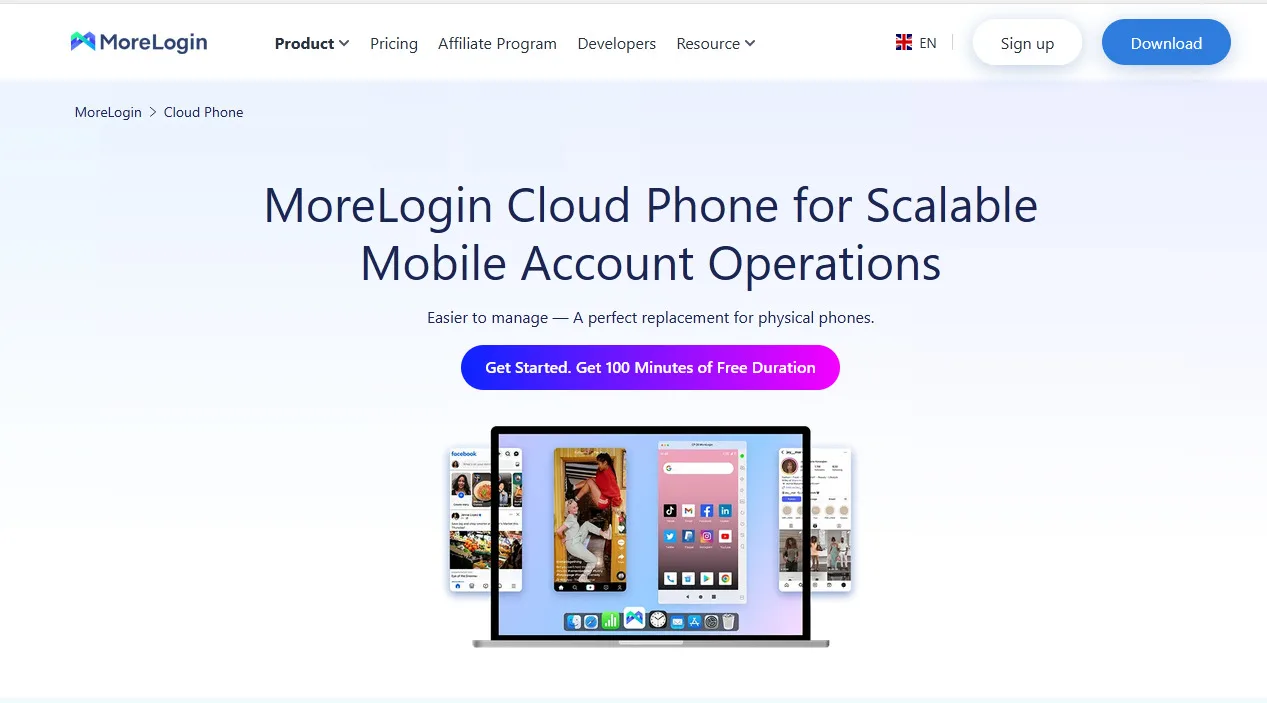
Similar to Gologin, MoreLogin is a long-standing antidetect browser that seized the cloud mobile phone opportunity ahead of many competitors. It’s a good fit for users who need strong automation features and a dependable business infrastructure that scales as they do.
It’s not the only provider to offer a Synchronizer, but MoreLogin’s version is among the most advanced. GeeLark focuses on live device interaction. Meanwhile, MoreLogin let me use more intricate commands like batch upload files and set up delays between taps.
Advanced functionality sadly makes MoreLogin less intuitive to use for newbies. There are lots of configuration options to go through, and many actions take several taps. Adding and configuring proxies isn’t straightforward either, especially compared to Gologin’s built-in proxies.
You can choose between monthly device rentals or pay 0.6 cents per minute per active phone. The former makes more sense for heavy use.
3. DuoPlus
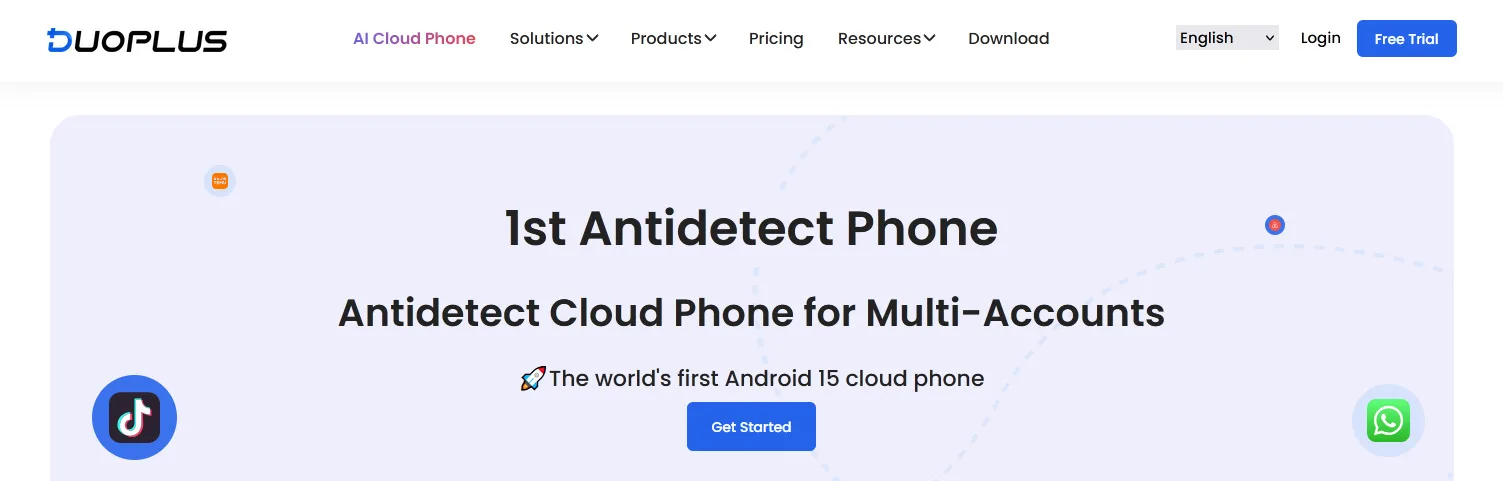
DuoPlus positions itself as a provider of large cloud phone matrices. That’s industry jargon for a coordinated group of phones tailored to various multi-accounting operations. Scale is front and center, as even the pricing page assumes you’ll hand over money for 10,000 devices by default.
And you just might at that, for several reasons. Some of the UI’s elements could use a redesign, but features and settings generally remain straightforward to access as you scale up phone use. Newbies might be put off by their first impression though. The setup process is straightforward, but then you’re asked to configure proxy details for the starter phones. They will NOT launch otherwise.
The phones’ actual performance is hit-or-miss. Initial startup times were among the slowest I’ve measured and only became worse when bulk launching new phones. Performance afterwards wasn’t stellar either. The intermittent lag I experienced wouldn’t affect most API and RPA workflows, but live synchronization would be tricky.
DuoPlus redeems itself with an above-average implementation of RPA features. The starter automations can already help you convincingly warm up social media accounts. An AI assistant makes creating new ones easy if you tell it what steps you have in mind. This makes the feature approachable for newbies.
4. VMOS Cloud
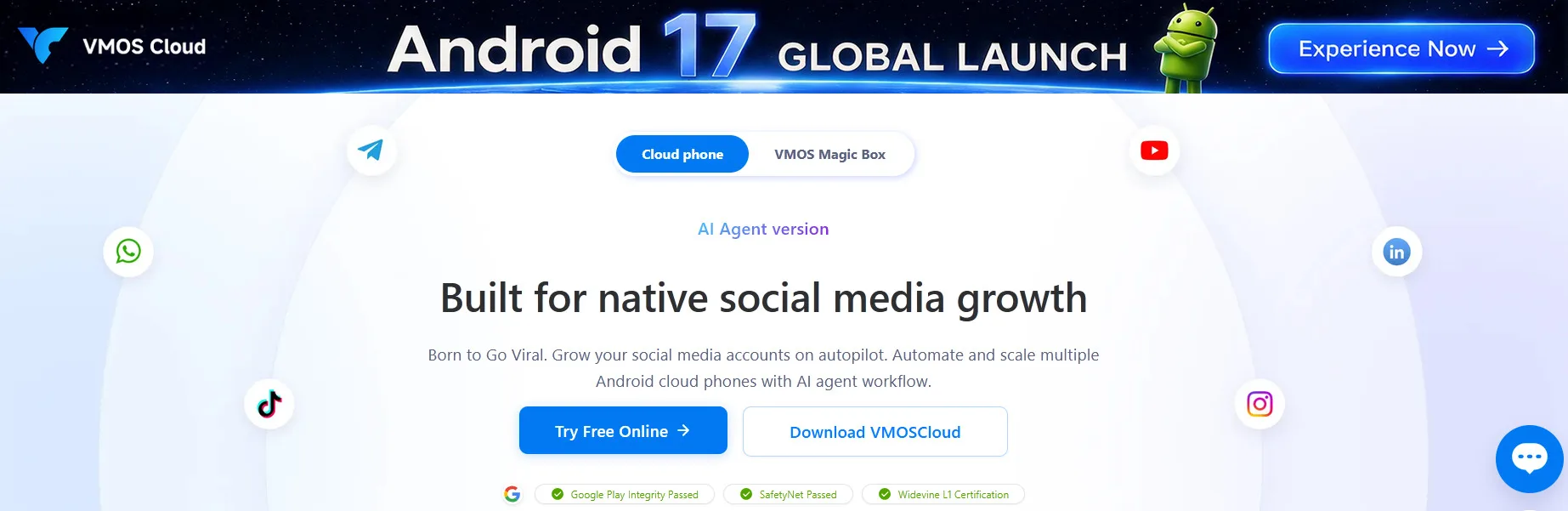
VMOS Cloud is part of a larger ecosystem designed to connect physical devices and manage virtual ones. The VMOS umbrella also features an Android emulator, screen sharing software, virtual phone environments running on local infrastructure, and even its own proxy network through OwlProxy.
This breadth of options is also visible in VMOS Cloud’s features. The standout is the ability to choose exactly which phones you want to rent. Undemanding or inexperienced users can just pick how much RAM and storage they need. There’s also the option to choose either ARM-based or physical premium phones.
This gives VMOS Cloud an edge for use cases where the model and make of a device matter. A dev might need it to ensure that an app they’re working on runs well on a specific low-end model. A gamer without the means of buying a flagship model might use the feature to play games they couldn’t otherwise.
Sloppiness is the reason VMOS Cloud ranks so low despite the impressive feature set. Part of the desktop UI still wasn’t translated from Chinese when I tested it. Some users also report that the supposed high-end phones aren’t nearly as snappy as they should be.
5. GeeLark
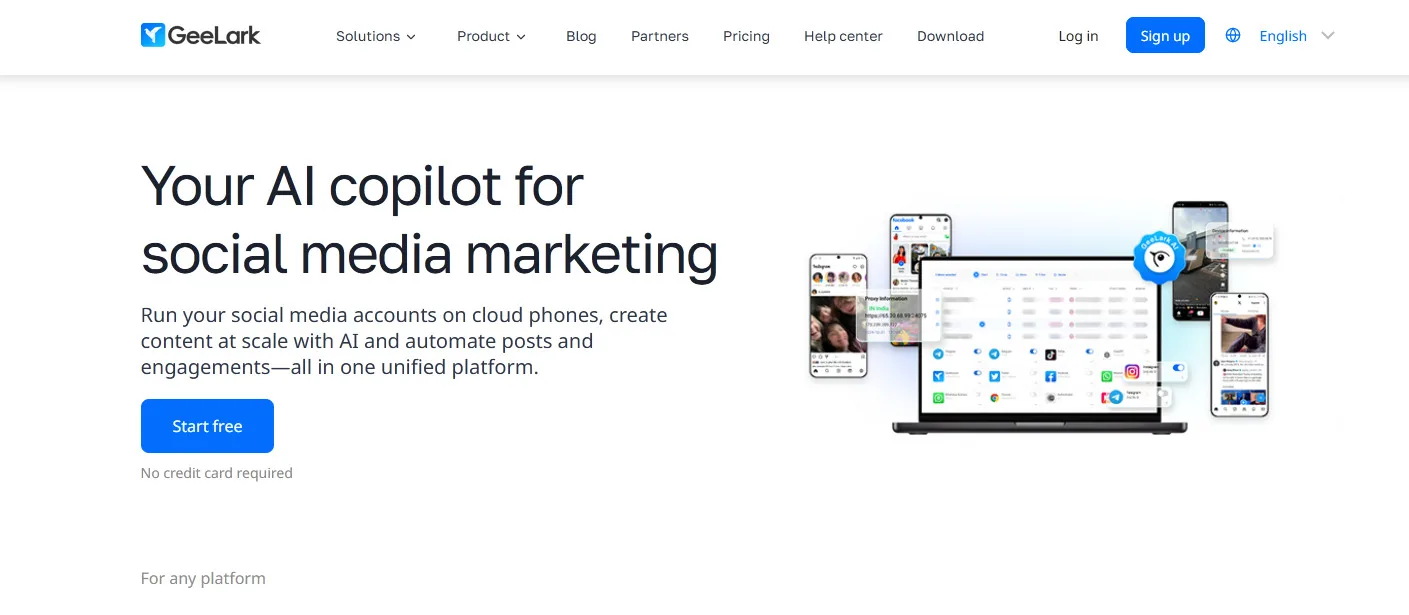
GeeLark’s pioneering release in 2025 showed how much better a tidy dashboard with minimal local resource drain is for social media account management than bulky phone farms. It’s still an innovator, judging by the AI-powered automations and video editing features that were introduced recently.
Social media account management remains GeeLark’s main focus. It’s competent enough as a general provider. But synchronization and many of the automations are made specifically to boost TikTok and Instagram account engagement. Synchronization is geared in that direction, with some of the smoothest and fastest multi-device replication I’ve seen.
The confusing pricing structure might put newer users off. You first have to choose a plan tier. Free exists but only really works for testing the service. You’ll want the Pro tier for access to synchronization. A fully functional phone costs $29.90/month. You can definitely use GeeLark to retire your phone farm, but you’ll need the money to do it.
6. RedFinger
The final provider I thought worth considering makes the best cloud Android phones for gaming. I was hesitant at first to include RedFinger since it didn’t have any aspirations beyond serving gamers for the longest time. Recently, that’s changed.
RedFinger uses a tiered system where you pay more for phones with more memory. You can also choose between several Android versions and server hosting locations. You can rent a phone for as little as a day or up to a year.
The beginnings of a suitable business tool are there, but RedFinger still has a long way to go. Its interface hasn’t been completely translated into English for one. Also, there are currently no tools or preinstalled apps that support the social media and mobile work-focused advertising RedFinger has started to adopt on its Google Play page.
Even setting all that aside, my user experience was at times frustrating. Phones would get sudden lag spikes and the desktop app logged me out after exiting each time.
Conclusion
I looked closely at what the cloud Android phone market has to offer and have two takeaways for you. The first is that despite still being fresh, there’s already decent differentiation. You’ve already got providers focusing on social media vs ones who cater to small, focused teams and ones who’re trying to innovate on the automation front.
The more important one is that neither your use case nor what a provider claims are good enough deciding factors. It doesn’t matter that you can spin up fifty phones if lag makes them unusable.
My insights can be a good jumping-off point. Be sure to also do your research and take advantage of trials to see cloud phones’ fit and performance firsthand.