

Proxyium Alternatives and Competitors

Proxyium is not that bad of a tool. I’ve used it quite a lot for quick basic stuff like bypassing geoblocks for platforms like YouTube or Netflix, but I stopped there. When I wanted to do some serious tasks, I avoided it at all costs because:
- It only gives me three server locations, and they are very slow
- It is strictly a web proxy, so it only encrypts traffic inside that specific browser tab
- Since it is a free web proxy, it uses shared data center IPs that are accessible to everyone and have high fraud scores, so they are easily detectable by websites as suspicious. I got banned multiple times because of this.
Even the community is not that happy about this platform, as it’s sitting at only 3.8 stars on TrustPilot.
And on Reddit, users are complaining that the US servers are painfully slow for streaming.
This pushes a lot of people to ask for alternatives to Proxyium. If you’re one of them, then you’re in the right place.
I’ve done some research and multiple tests, and I found a list of 8 Proxyium competitors and alternatives that made me never look back again.
Let’s see what they are.
TL;DR
| Tool | Category | Primary Use Case | Key Advantage |
| 1Browser | Anti-detect Browser | Multi-accounting & high-privacy tasks (social media, banking) | Spoofs entire digital fingerprints, 10 free isolated profiles, built-in proxies. |
| Floppydata | Premium Proxy Provider | High-security tasks, SEO research, and precise geotargeting | 95% clean IP rate with 195+ locations |
| ProxySite | Web Proxy | Fast video streaming & basic bypasses with slight browser tweaks | Built-in gigabyte network architecture |
| CroxyProxy | Web Proxy | Loading modern Javascript web apps & seamless media streaming | Application-level script engine that easily handles complex sites |
| BlockAway | Web Proxy | Accessing sites without layout/script breaking | Code rewriting engine that strips blocking scripts |
| Bright Data | Enterprise Data Infrastructure | Large-scale web scraping, data collection, and anti-bot bypassing | 400M+ ethically sourced residential IPs with advanced ASN/ZIP targeting and solver APIs. |
| Oxylabs | Enterprise Data Infrastructure | High-end automated scraping & steady web session management | 195M+ proxy pool, AI-powered web unblockers |
| FlyProxy | Premium Proxy Provider | Cost-effective scaling for independent developers & multi-threaded scripts | Extremely budget-friendly residential IPs |
Top 8 Proxyium alternatives and competitors for 2026
1Browser
I’m going to talk to you first about my favorite Proxyium alternative.
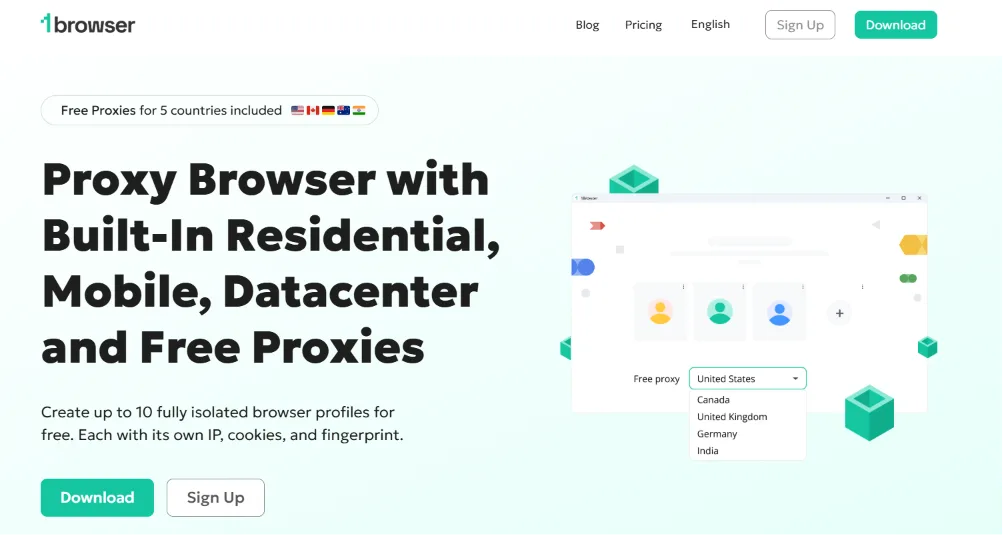
1Browser is an anti-detect browser that spoofs your entire digital fingerprint, not just your IP address.
When using Proxyium, you actually get a new IP address with every new connection; however, with 1Browser you can create up to 10 profiles for free, and with each profile, you can get its own IP, its own cookies, and history. That way, you actually get 10 different stable identities, which is great because websites will see you as a legitimate machine that has a regular IP that they will trust.
Thanks to the different profiles you can create, you avoid cross-contamination. And with that, you avoid captchas and bans. That’s why it is more adequate than Proxyium for tasks that require high privacy, such as social media management and banking.
Additionally, you can use up to five proxies for free, plus you can get 500 MB of data center proxies for speed. These proxies are integrated inside the browser, so you won’t need to get them externally.
What’s great about 1Browser is that it looks just like Chrome, so you won’t have any learning curve that will slow you down. All you have to do is download the browser and create your first profiles to get started; nothing different from your usual browser, only more privacy and security.
Lastly, if you have any problems at any moment, you can contact their support team, and I’ll answer extremely fast with very helpful insights.
Floppydata
Next is Floppydata, which is an absolute beast compared to Proxyium.
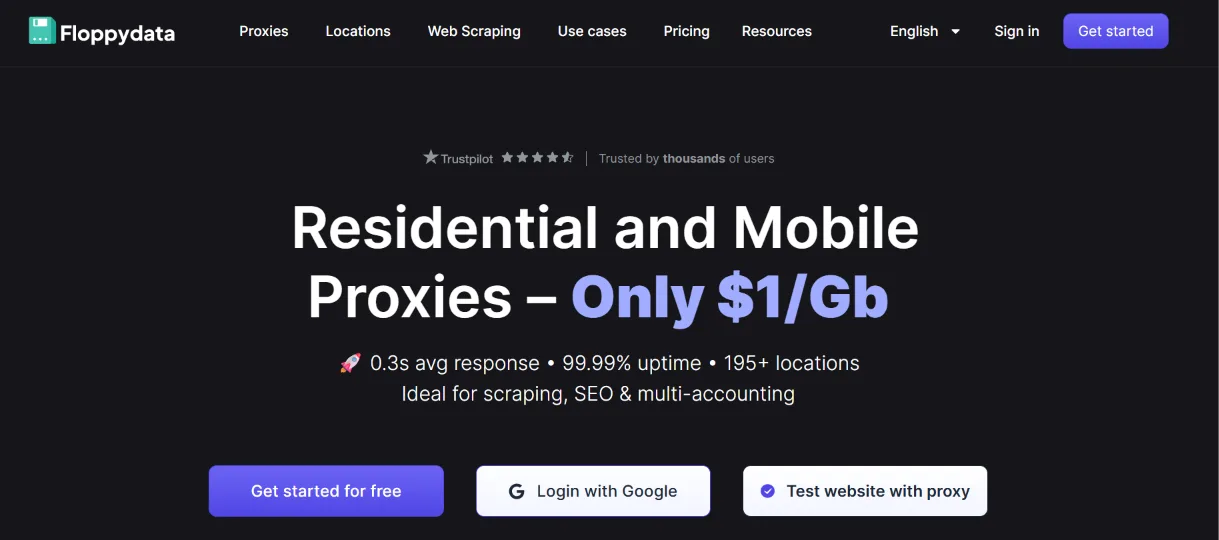
It has an insane 95% clean IP rate that the Floppydata team is constantly working to keep high and impressive.
This means when using the Floppydata proxies, you won’t get stuck in an endless loop of annoying Cloudflare CAPTCHAs or instant IP bans.
It also gives you the choice between residential, mobile, and ISP proxies so you’re not stuck with only bad-quality datacenter proxies like the ones Proxyium offers
It covers over 195 locations worldwide, and you can do hyper-precise geotargeting for SEO research, price monitoring, or regional content access across hundreds of thousands of clean IPs.
The speed is also on another level with 0.3s response time and 99.99% uptime. So if you want to do tasks that require high-security IPs, speed, and reliability, then Floppydata proxies are the answer.
Smart tip: use your Floppydata proxies on 1Browser because you can integrate them in its settings very easily – this will increase your security and anonymity tenfold because it’s one of the best anti-detect browsers on the market!
ProxySite
Let’s now see how ProxySite stacks up against Proxyium.
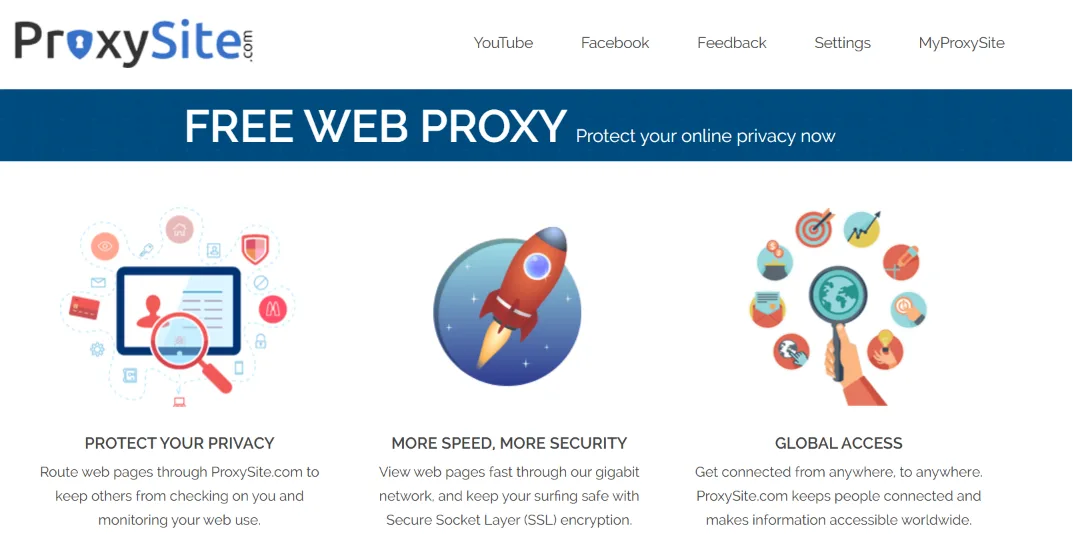
First, ProxySite gives you 20 distinct US servers and 20 EU servers. Reminder: Proxyium gives you only three, with the US server being the slowest.
Video playback and page rendering are also way superior on ProxySite than with Proxyium, and that’s due to its built-in gigabyte network architecture.
With ProxySite, you also get more flexibility with advanced configuration options, where you can change your user agent string and your HTTP headers directly from the settings page. With Proxyium, I feel that I am way more restricted and limited because it doesn’t allow me to make any tweaks, and my default browser identity stays totally exposed.
Plus, ProxySite allows you to manage scripts and purge session cookies, Proxyium doesn’t allow any of that.
So, although ProxySite is vague about its data retention policies, it is still a good alternative to Proxyium.
Croxyproxy
CroxyProxy is another great alternative to Proxyium. Let’s see why.
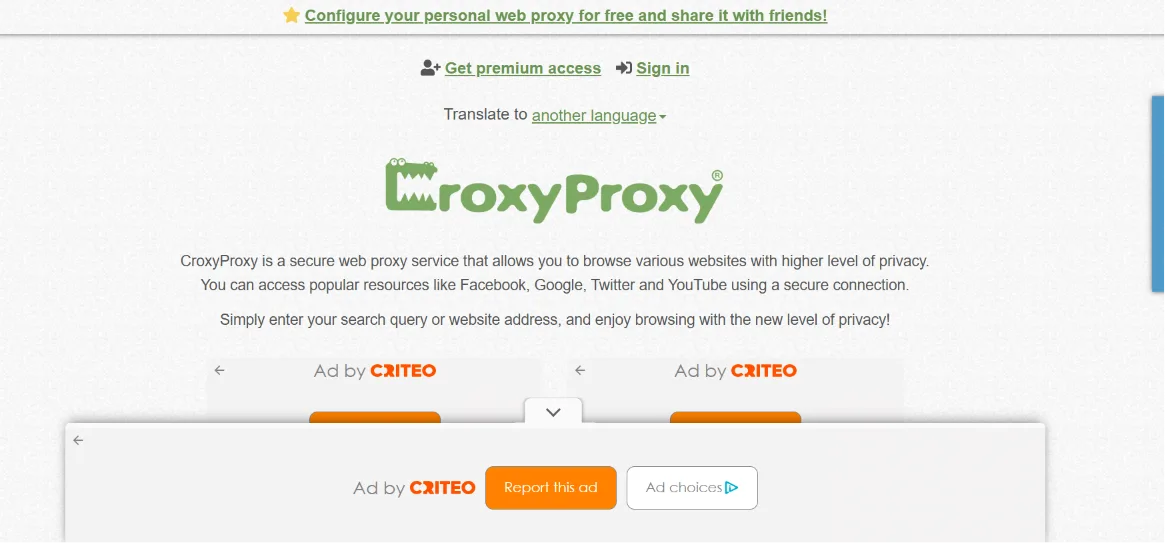
First, CroxyProxy uses an advanced application-level script engine, so it can perfectly load modern JavaScript web apps with no problem.
When I tried to load TikTok on Proxyium, it was horribly bugging and it looked weird; with CroxyProxy, it was smoother.
Speaking of TikTok and video streams, CroxyProxy isolates media streams and supports native HTML5 videos/audio playback protocols, so as a dedicated YouTube proxy, it works amazingly without messing up the UI layout or capping playback resolution.
CroxyProxy is generally also more secure, and it has a dedicated browser extension that you can use for one-click proxy routing for individual tabs.
BlockAway
Next app is BlockAway, which is very similar to CroxyProxy visually and also in performance, with a little plus.
So I tried loading some style sheets and images on Proxyium, and it failed so badly.
When I tried to do it on BlockAway, I didn’t experience any page layout crashing, because apparently it completely passes and strips the source code and dynamically rewrites every single internal link, script, and style sheet to route through its proxy tunnel.
BlockAway also allows you to interact with dynamic web interfaces thanks to its persistent, reverse proxy tunneling.
It is also way faster than Proxyium because of the downstream data compression and edge caching.
But at the end of the day, it is still only a Web proxy and not an anti-detect browser like 1Browser, so privacy is not that good.
Bright Data
Now we’ll jump to a completely different planet than Proxyium: Bright Data.
It is an enterprise-grade web data infrastructure that gives you a pool of over 400 million rotating residential ISPs and mobile IPs across 195 countries.
Every IP is ethically sourced from real user devices. The specific targeting is also very interesting, as Bright Data allows you to target a specific country, state, city, ZIP code, mobile carrier, or even an ASN.
It also has built-in anti-bot and CAPTCHA solving APIs. So while proxy crashes at the first anti-bot barrier, Bright Data felt like a huge upgrade.
What’s also great is that Bright Data gives you proxy credentials supporting HTTP, HTTPS, and SOCKS5 protocols with unlimited concurrent sessions that can handle multiple parallel requests simultaneously with a 99.95% success rate. That’s similar to what FloppyData offers.
However, the pricing is a bit high, and if you’re someone who is used to the free service that Proxyium offers, you may feel like the barrier to entry into Bright Data is huge.
Oxylabs
The next app is Oxylabs, and when you hear about it, you will realize how basic Proxyium actually is.
Oxylabs offers over 175 million residential proxies and 20 million mobile nodes. And when you get a proxy, you can either activate automated rotation or activate sticky sessions that can last up to 24 hours, and by using the same IP fingerprint for this long, websites will see you as a real user and trust you more.
They also have an AI-powered web unblocker and an automation to handle request headers for you on your behalf.
It also lets you filter your entries by IPv4 or IPv6 stacks, and it lets you target premium autonomous system numbers (ASNs) or specific mobile carriers of your choice.
All this is great and looks like a huge step up from the basic service that Proxyium offers. However, it comes with a bigger price tag, which makes sense in my opinion.
Flyproxy
Another competitor to Proxyium is FlyProxy. It’s the last alternative on this list, but definitely not the least.
First, it is not that expensive, so it bridges the gap between massive, corporate-focused platforms and independent developers.
It’s not only limited to HTTP/HTTPS requests like Proxyium, it also implements native SOCKS5 protocols.
The average response latency is 0.6 seconds, which is quite fast and highly effective for multi-threaded scripts or tools that a web proxy just cannot even load.
FlyProxy also gives you a pool of over 100 million real residential device IPs, which is a big step up from the three burned-out data center server IPs that Proxyium offers.
And while usually premium residential proxy networks cost $8 per GB, FlyProxy entry packages drop all the way down to 0.8 $ per GB.
How did I pick the best Proxyium alternatives?
The search took me a few months of trial and testing. I also went through a few Reddit threads and user reviews on Trustpilot and G2. That way, I made sure to make a comprehensible list of the best possible alternatives to Proxyium. Each and every element of this list meets certain criteria; here’s my checklist:
- It must perfectly hide my real IP address without any leaks It must perfectly hide your IP address without any leaks
- Response times need to be consistently fast, ideally around 0.3s
- I need flexibility, so there must be a possibility to choose between residential, mobile, or datacenter IPs
- Since Proxyium is easy to use, I needed to find an alternative that is as intuitive and easy
- And finally, I need to see concrete positive feedback from the tech community and the users online
Conclusion
A web-based proxy like Proxyium is fine for quick geo-unblocking or basic web surfing, but for a bit more complex tasks, especially those that are related to business, social media, banking, or SEO. Then you need to level up your game a little.
Websites no longer just look at your IP address. They also use sophisticated browser fingerprinting to gather as much information as possible about you, your device, and your connection. To bypass all this, you need the perfect ecosystem. I personally use 1Browser because it combines the simplicity of a web proxy with the bulletproof security of an anti-detect browser.