
Proxy vs VPN: Understanding the Key Differences

A friend of mine, not Derek for once, a different friend, called me in January and said she’d had three Instagram accounts disabled in one week while using NordVPN. She was confused because she thought the VPN was supposed to prevent exactly this.
I asked her if all three accounts were going through the same VPN connection. She said yes. I asked if she was using separate browser profiles. She said she was using separate Chrome windows. I said “those aren’t the same thing” and she said “what” and that conversation is basically this entire article.
The short version of what is a vpn vs proxy: a VPN encrypts everything on your device and sends it through one server. A proxy routes specific browser traffic through a different server per session. For privacy, VPN.
For running multiple accounts that need to look like separate people, proxy. Both have strengths. Both have weaknesses. The difference between proxy and vpn is that they solve different problems, not that one is better.
How I Figured This Out (Slowly, Expensively)
I used ExpressVPN for about three years for absolutely everything. Coffee shop wifi, hotel networks, streaming, managing client social media accounts. It handled the first three perfectly. It was catastrophically wrong for the fourth one and I lost six client accounts before I understood why.
The VPN was working exactly as intended, every single one of those six accounts was encrypted and going through the VPN server. The problem was they were all going through the same VPN server with the same fingerprint looking like one person with six Instagram accounts, which is what they were.
My friend Derek told me to try proxies. I said I didn’t want to set up proxies. He said I didn’t want to keep losing client accounts either. Fair point.
I spent about two months using proxies badly before I figured out the right approach, which involved realizing that proxies alone weren’t enough either because the browser fingerprint was still shared across all my profiles. But I’ll get there.
The Stuff VPNs Do Better and I’m Not Going to Pretend Otherwise
Full device encryption. Everything. Not just your browser, everything. If you’re on a network you didn’t set up, like a hotel or a conference or a coworking space where you’re not sure who else is on the wifi, VPN is the right call and proxies aren’t a substitute for this. I’m saying this on a proxy company’s blog and I mean it.
One-click setup. My mom, who is the person I calibrate “ease of use” against, handles ExpressVPN on her phone without ever asking me for help. If I tried to explain proxy configuration to her she would stop speaking to me and honestly I wouldn’t blame her.
Casual geo-unblocking. Streaming Netflix from another country, accessing a site that’s blocked in your current location. VPN does this instantly. Using a proxy for this is technically possible but unnecessarily complicated for the task. The VPN vs proxy server choice here is VPN, clearly.
The Stuff Proxies Do That VPNs Literally Cannot
Separate identities per session. This is the thing. A VPN gives you one pipe and everything goes through it. You can’t have five different IPs at the same time for five different browser profiles on one device through a VPN.
A proxy lets you do exactly that. Each profile, its own IP, its own location. Combined with an antidetect browser, its own fingerprint, its own cookies, its own timezone. Five browser sessions that look like five different people on five different computers in five different cities. Instagram can’t link what it can’t see is connected.
Better ISP survival in censorship countries. I’ve been in Turkey during internet crackdowns where VPN protocols got throttled to zero throughput. Connected, green icon, nothing loading.
Proxy traffic on the same connection at the same time went through at near-normal speed because it looks like regular HTTPS. The ISPs were targeting VPN protocol signatures specifically. Proxy traffic doesn’t have those signatures.
Speed. No encryption overhead. For scraping ten thousand product pages or doing high-volume research operations the difference is measurable. Not huge per request but huge across thousands.
The Stuff Proxies Are Worse At (Also Being Honest)
No device-wide protection. The proxy covers the app or browser you configure. Everything else goes through your raw connection. Don’t do banking through a proxy on airport wifi. Use your VPN for that.
Setup is harder. Not hard-hard. But not one-click either. You configure per profile, manage credentials, choose between sticky and rotating sessions. There’s a learning curve. VPNs don’t have a learning curve, they have a green button.
IP quality is your problem. With VPNs you pick a brand and it mostly works. With proxies you need to evaluate whether the provider’s IPs are contaminated by previous users. I’ve bought residential IPs that were already banned on Instagram before I used them. That’s worse than no proxy at all. Provider selection matters in a way it doesn’t with VPNs.
Comparison
| Feature | VPN | Proxy | Winner | Notes |
| Encryption | Full traffic | Usually none | VPN | HTTPS proxies exist |
| Speed | Slower | Faster | Proxy | No encryption overhead |
| Coverage | Whole device | Per-app/browser | Depends | |
| Multi-accounting | No fingerprint help | Combine with antidetect | Proxy | The big one |
| Setup | One click | Needs config | VPN | |
| ISP detection | Protocols detectable | Looks like HTTPS | Proxy | Country dependent |
| Price | $3-12/mo flat | $1-8/GB or free | Depends | |
| Trust | Provider sees all | Provider sees all | Tie | Trust issue either way |
What I Use and What I Tell Other People to Use
Personal use, public networks, travel: ExpressVPN. It’s in my toolbar. I click it at every hotel and airport. It’s been there for years and I’m not replacing it.
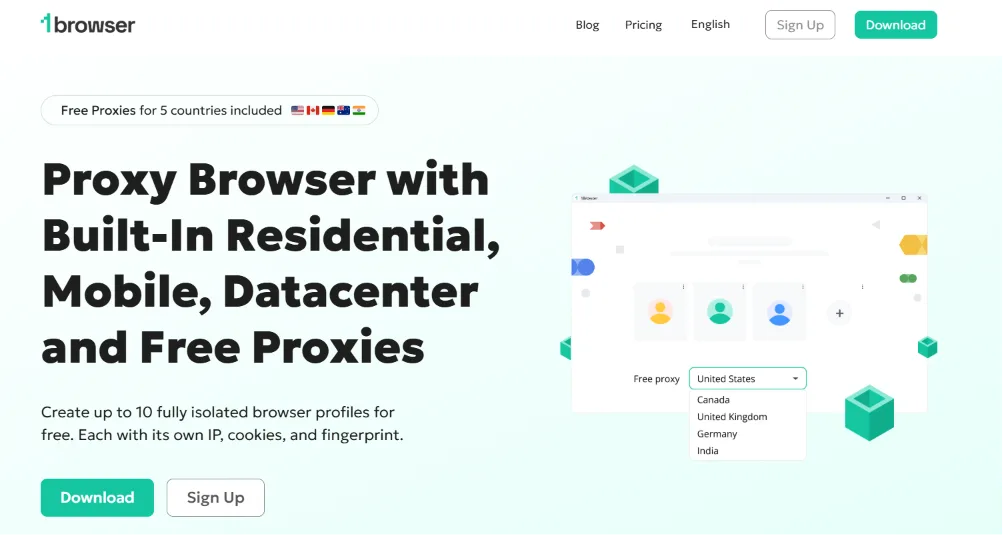
Professional multi-account work: Floppydata for residential IPs, clean pool, about $25/mo for the accounts I manage. And 1Browser for the antidetect browser side, each profile gets its own fingerprint, own cookies, and its own proxy.
Ten free profiles, no credit card. The combination handles the proxy side of the equation and the fingerprint side which is the part the VPN was never going to solve no matter how good the VPN was.
I told Derek I was going to write this article and he said “just tell them to use both” and I said “that’s literally the article, it’s a thousand words that could have been two” and he said “well now you know how I felt explaining it to you for six months.” So there’s your VPN vs proxy answer. Use both. They do different things. Neither replaces the other. Derek sends his regards.