

Best Proxy Providers in Germany: How to Get a German IP Address without VPN?

Despite enjoying a high degree of general internet freedom, the German digital landscape is notoriously difficult to approach from the outside without running into unnecessary roadblocks.
I got to experience that firsthand when I tried to score some shoes from Zalando.de only to be redirected to their international selection. It’s even more impactful for entrepreneurs or marketers who’ve never dealt with Germany’s regional fragmentedness or witnessed how much SERPs differ from Köln to Frankfurt.
You might think that VPNs are the answer. Related marketing has been working overtime for years, so I don’t blame you. However, you don’t need a privacy tool to verify ads or automate scraping; you need a reliable proxy provider.
But if you go searching for “proxy Germany” online, you’ll quickly run into droves of provider one-pagers that promise a lot while explaining little. I researched and put together this guide to help you make an informed decision based on use cases and criteria that actually matter.
Let’s start with the facts, in table form.
The Best German Proxies at a Glance
| Provider | German
IP pool |
State and city targeting | ISP and ASN targeting | Uptime | Starting prices | Trials |
| Floppydata | 1M+ | ✅ Yes | ASN | 99.9% | $1/GB residential, datacenter, and mobile | $1 trial |
| Oxylabs | 6.2M+ | ✅ Yes | ✅ Yes | 99.9% | $6/GB residential
$7.50/GB mobile $0.59/GB datacenter |
5 free datacenter IPs |
| Decodo | 2.3M+ | ✅ Yes | ✅ Yes | 99.9% | $4/GB residential
$7/GB mobile $0.70/GB datacenter |
Free, data capped |
| Bright Data | 2M+ | ✅ Yes | ✅ Yes | 99.9% | $8/GB residential and mobile
$0.60/GB datacenter |
7-day free |
| NodeMaven | 200K+ | ✅ Yes | ✅ Yes | 99.99% | $4.25/GB residential and mobile | $3.50 for 1GB of test traffic |
| IPRoyal | 2M+ | ✅ Yes | ✅ Yes | 99.9% | $1.75/GB residential
$10.11/GB mobile $1.35/IP datacenter |
Free for business |
| SOAX | 1.1M+ | ✅ Yes | ✅ Yes | 99.9% | $3/GB residential, datacenter, and mobile | $1.99 for 450MB, valid for 3 days |
| Infatica | 116K+ | ✅ Yes | ✅ Yes | 99.9% | $4/GB residential
$8/GB mobile $1/IP datacenter |
$4 for 1GB of test traffic |
| MarsProxies | 316K+ | ✅ Yes | ❌ No | 99.9% | $4.99/GB residential
$8.49/GB mobile $0.99/IP datacenter |
$4.49 for 1GB of test traffic |
| DataImpulse | 300K+ | Caveats | Caveats | 99.9% | $1/GB residential
$2/GB mobile $0.50/GB datacenter |
$5 testing tier |
Methodology: Reasons Behind the Rankings
As you’ll see when going over the actual rankings, the kind of data that’s easy to put in a table doesn’t necessarily make it clear which provider you should go for. Millions of IPs are nice to fall back on, and premium pricing usually means standout features. But in the context of a country as specific as Germany, the importance of the criteria looks something like this:
- German IP quality – I prioritized providers with reputable IP pools that reliably support a wide range of tasks.
- Geographic precision – How well a provider handles targeting by Bundesland, city, etc.
- Scalability – Whether a given provider can keep up with greater customer demands.
- Connection reliability, uptimes, and sticky session handling
- IP pool size and variety
- Pricing – Both the actual price you pay for the service and what you get in return.
- Ease of use
- Reputation – If it were only up to marketing, every provider would be number one. I researched review sites and read about the experiences of Reddit users to get a clearer and less biased picture.
German Proxy Providers, Ranked
1. Floppydata
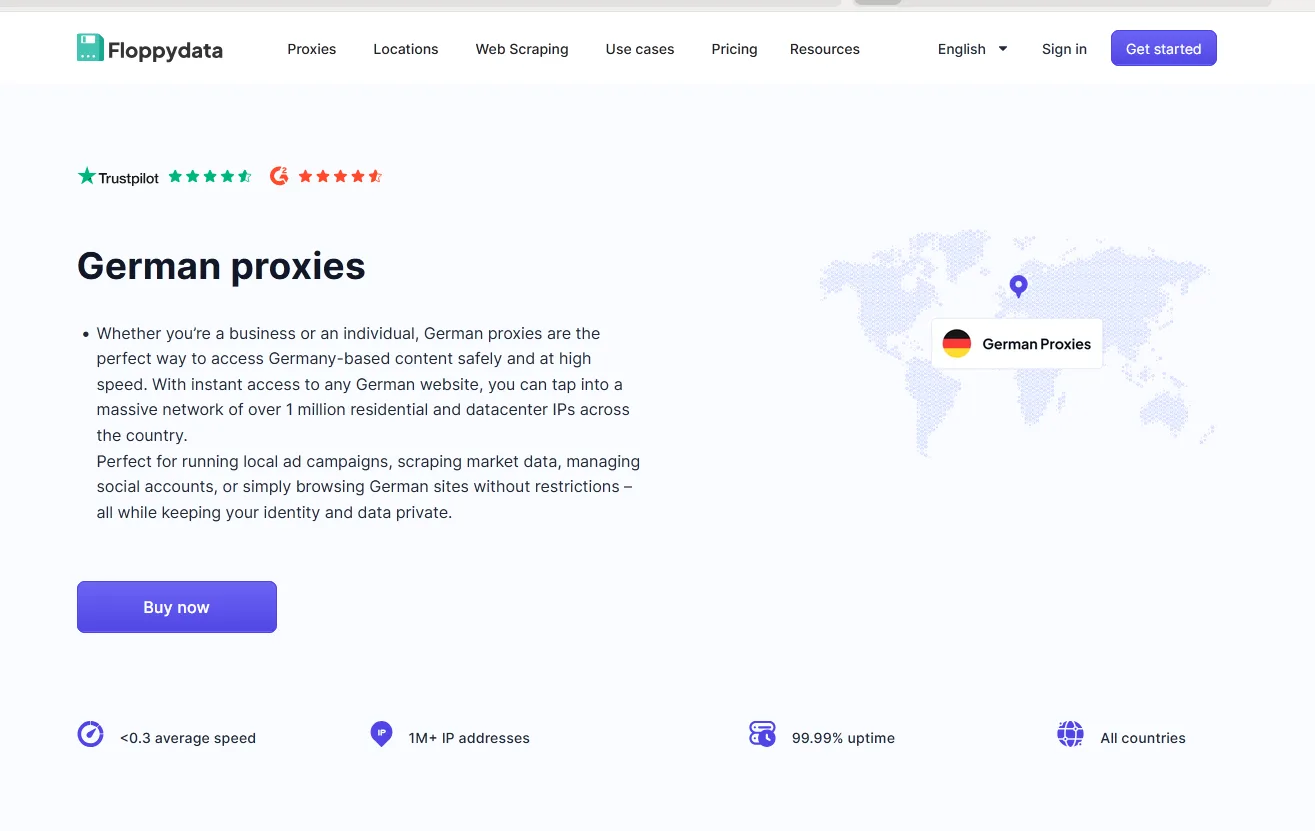
Enterprise clients might be better served with Oxylabs’ larger IP pool or Bright Data’s infrastructure. Still, I put Floppydata on top because it’s a better, more balanced provider for everyone else. It’s ideal for freelancers, SMBs, and anyone who needs practical coverage at accessible rates.
A million IPs spread across datacenter, residential, and mobile proxies is healthy coverage for a country the size of Germany. The dashboard makes it easy to generate new IP pools based in the Bundesland and city of your choice. I found the sticky session setup and usage statistics straightforward as well.
Floppydata lets you get a feel for searching Google.de, Zalando, etc., with a widget where you type in an address and use Germany as the proxy country. At $1/GB regardless of proxy type, even committing won’t set you back much.
This is especially affordable for mobile traffic, since even competitors who otherwise price aggressively charge a lot more. More importantly, it means you don’t have to look for an alternative if your priorities or scale change.
2. 1Browser
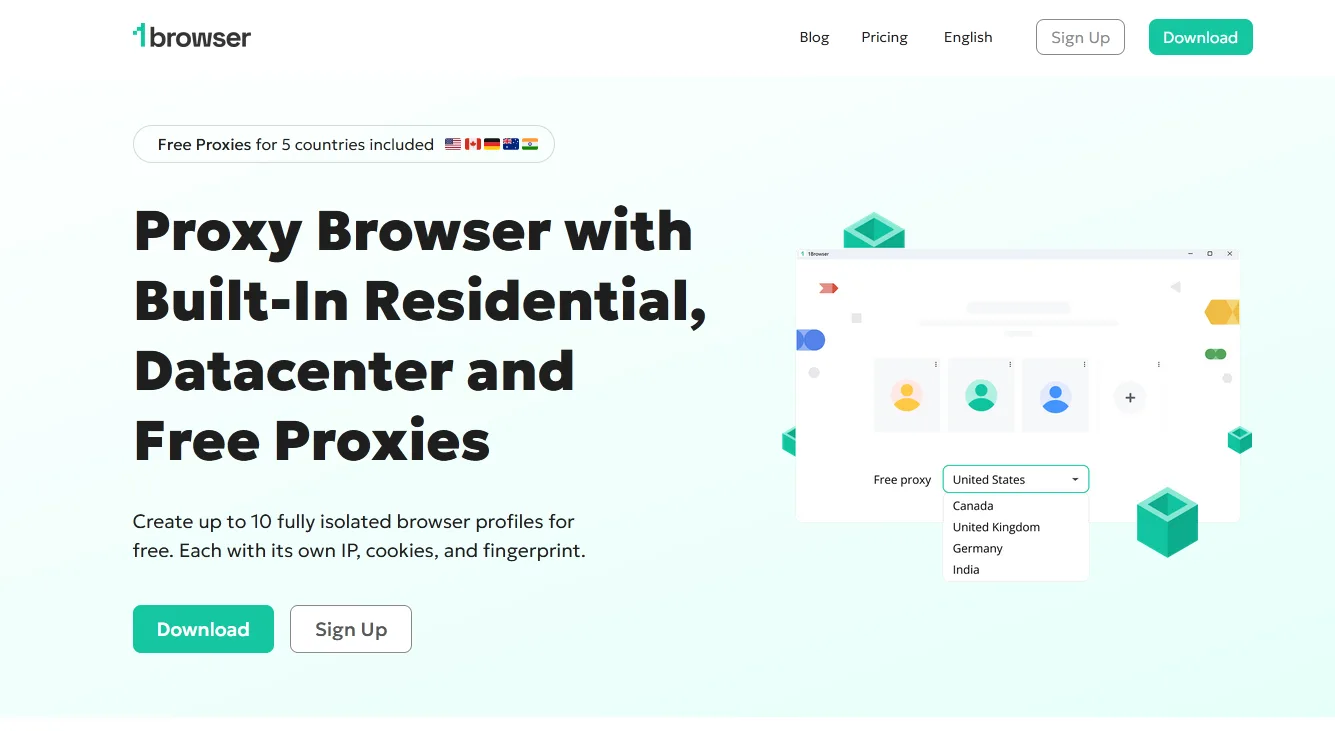
1Browser uses built-in residential, mobile, and datacenter proxies. Germany is also one of the five countries whose IPs you may use to test 1Browser’s features out for free. But that’s not why it’s so high on the list. Rather, I wanted to draw attention to it as an essential tool for augmenting proxy use.
Let’s say you run a distributed marketing team that’s working on campaigns for several German clients. It’s a tricky situation where members may need to access different accounts from stable environments to not trigger extra verification steps, even though they’re doing nothing wrong. A clean German IP alone won’t cut it.
However, that IP is crucial for creating an isolated profile in 1Browser that behaves consistently regardless of where you access it from or who you share it with. Each of these profiles has a unique hardware fingerprint and cookie settings. This makes separating client-specific workflows and account environments easier without affecting access.
3. Oxylabs
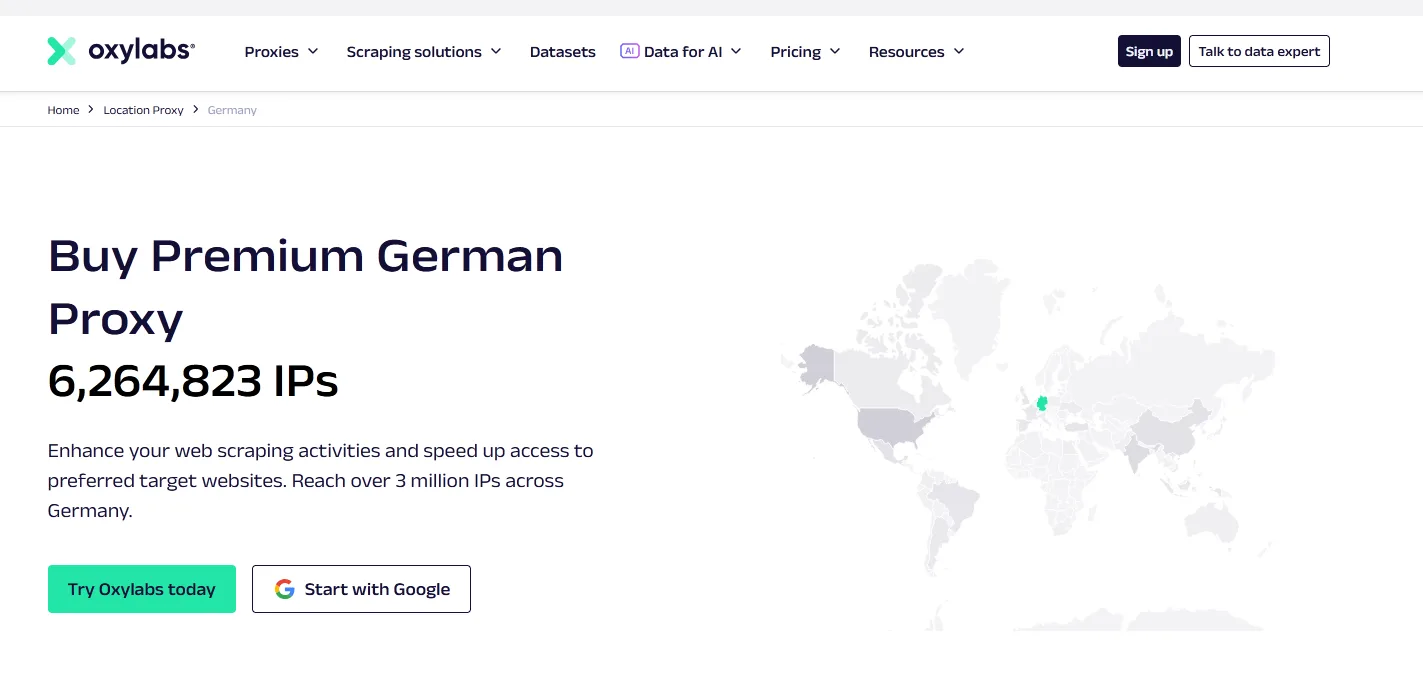
Enterprise clients operate on a whole different level. For example, a retailer who wants to break into the German market might need to make millions of Idealo requests to assess the competition. Oxylabs has the vast IP pool and scraping-oriented infrastructure to support this.
Signing up for Oxylabs means paying a premium that turns smaller users away. But if you can afford it, you’re getting reliable access at scale. When you operate at this level, failed requests or inconsistent location data end up costing far more than proxy traffic.
4. Decodo
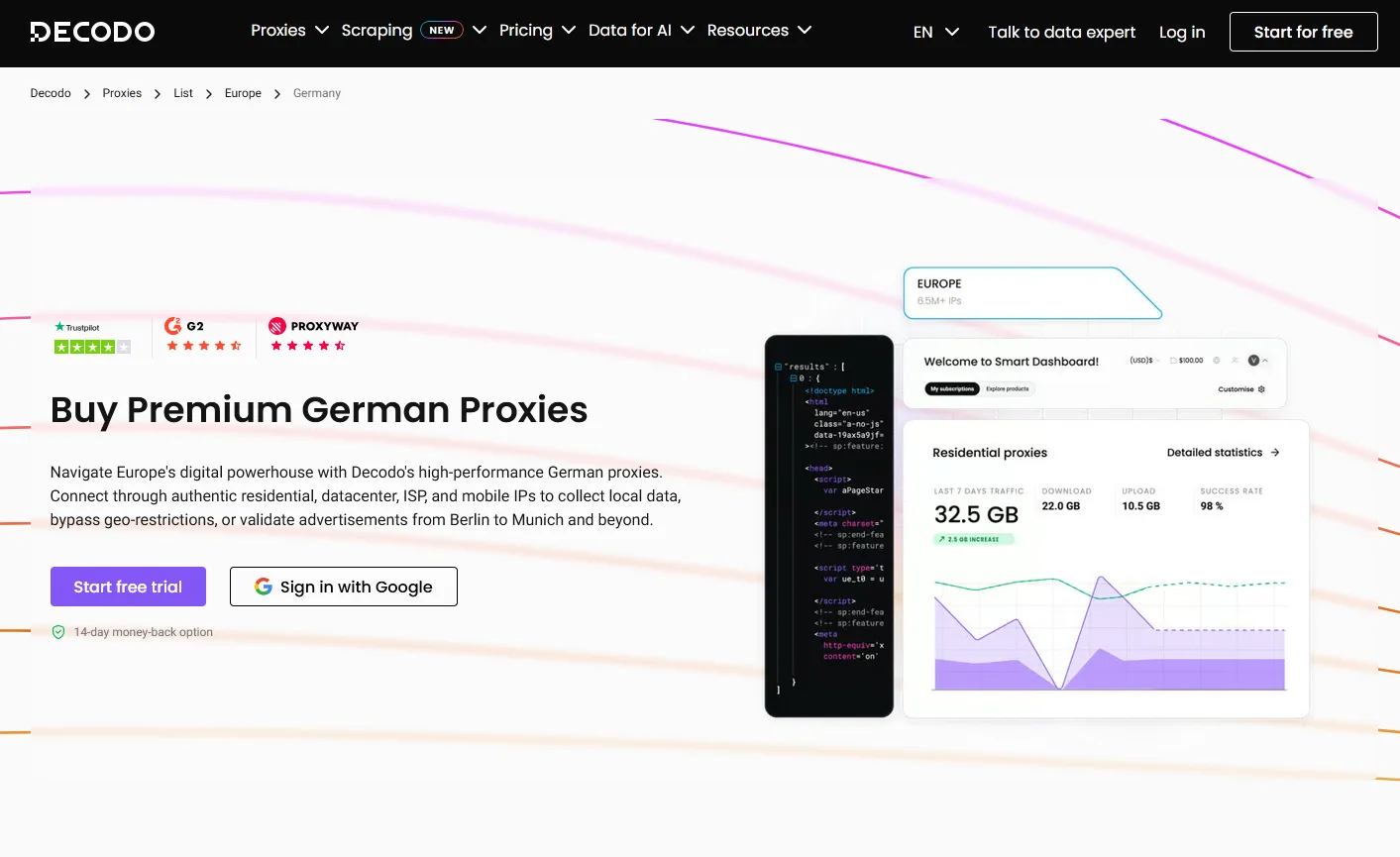
German users are shifting away from desktop and embracing mobile more, especially in e-commerce. As impressive as large residential IP pools are, I found that Decodo’s focus on ethically-sourced and abundant mobile IPs was a strong argument for high placement.
It’s a solid option if you regularly verify ads on Kleinanzeigen or Otto and need to do so from real mobile IPs. Pricing positions Decodo as a mid-tier provider, and you do pay a premium for using those mobile addresses. That said, an advanced suite of AI tools and website unblockers makes it feel like you’re getting more bang for your buck.
5. Bright Data
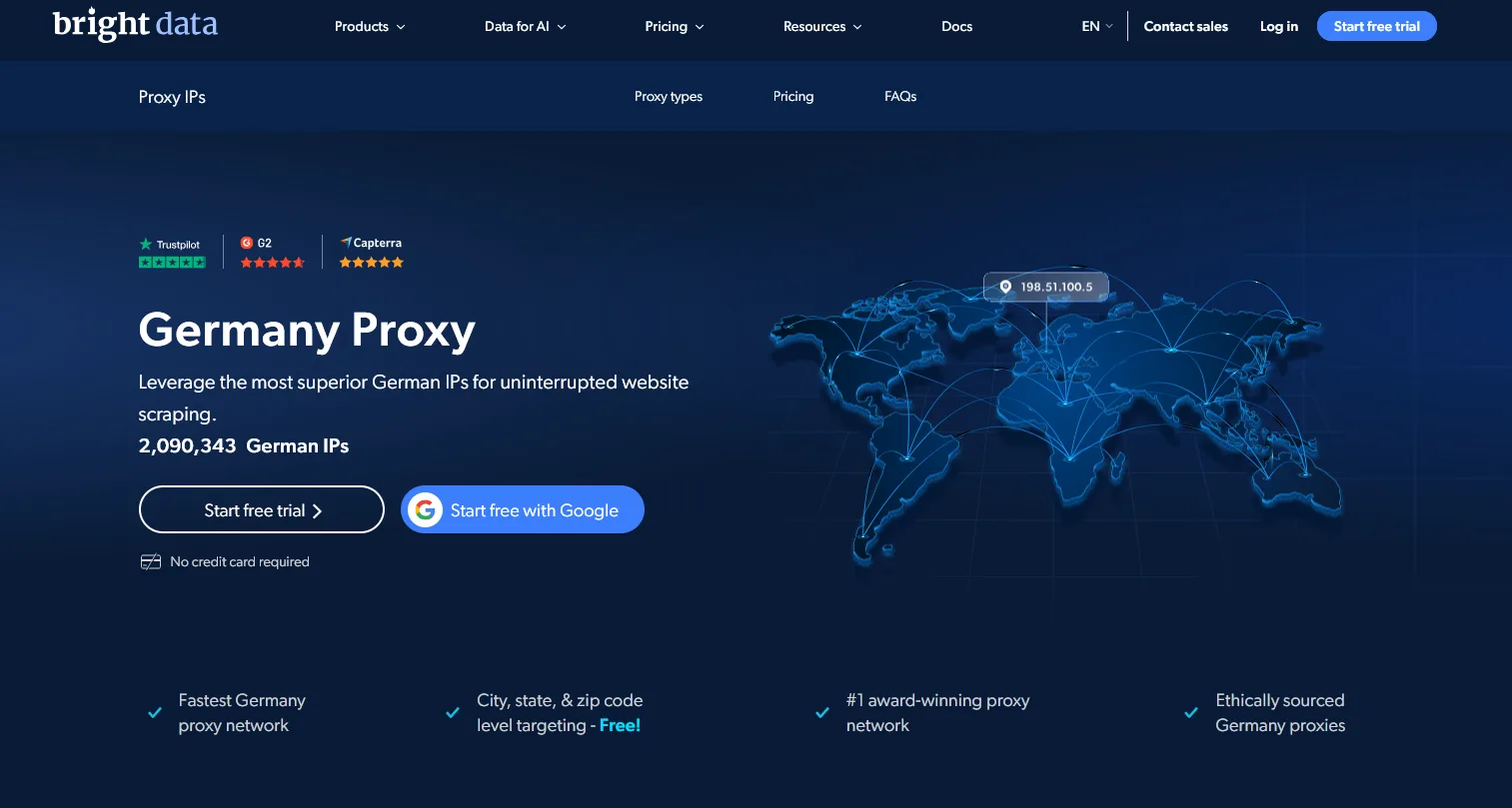
Despite having a leg up in terms of overall size, that’s not the main factor I’d consider when deciding between Bright Data and Oxylabs if I were an enterprise client. In the context of German usage and market intelligence, Bright Data would sound tempting both due to its raw proxy capabilities and the accompanying tooling instead.
On the one hand, clients with dedicated and experienced data collection teams can get the best use out of its proxy infrastructure. On the other, they can outright buy relevant datasets or commission Bright Data to produce missing ones. Unsurprisingly, the pricing matches the level of service.
6. NodeMaven
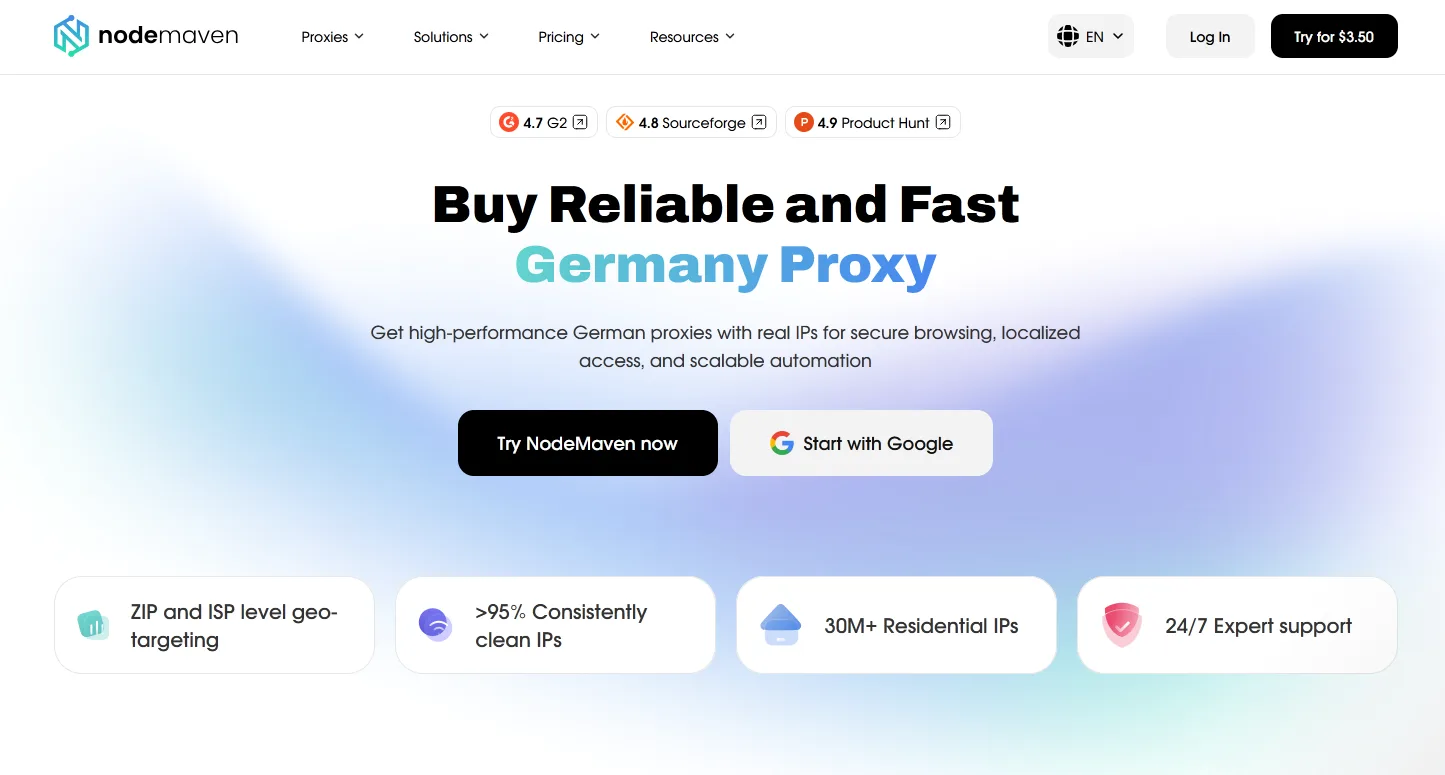
Whenever I write about testing proxies, I keep emphasizing how a large proxy pool isn’t a reliable metric. Case in point, NodeMaven’s high placement as a viable proxy provider for Germany. It might only give you access to around 200K IPs, but NodeMaven diligently checks them for quality. I’d rather have fewer dependable IPs than face yet another block because of a shoddy one.
Reliable sticky sessions complete NodeMaven’s two-hit combo. They’re key for situations when continuity matters. For example, if you’re completing a lengthy checkout from a German store or need to maintain an IP for complex data extraction. The fact that NodeMaven doesn’t offer datacenter proxies isn’t a deal breaker for German usage, but mid-to-high pricing might put their advantages out of some people’s reach.
7. IPRoyal
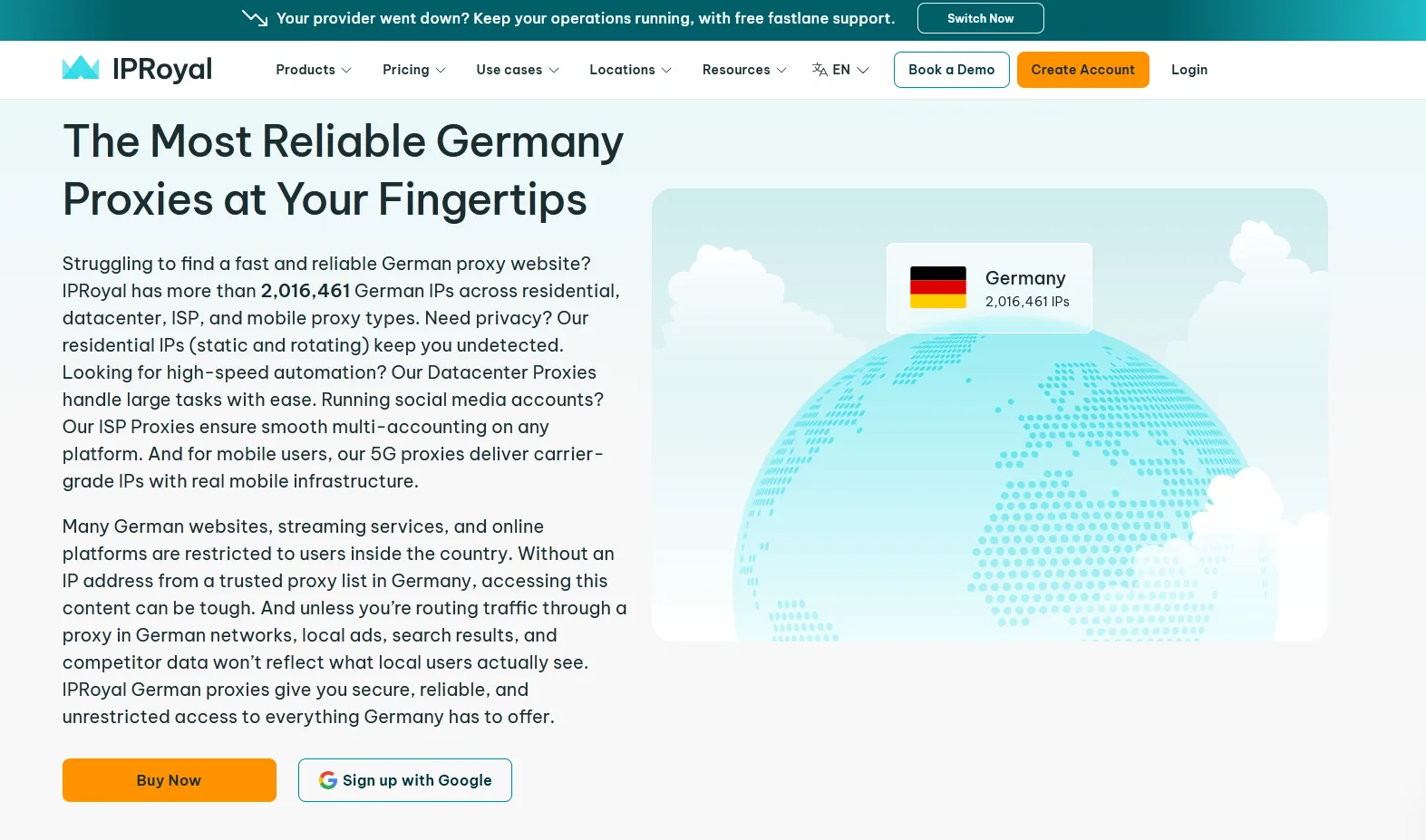
The thing I find most fair about providers like Floppydata and IPRoyal is their transparent pricing. I don’t just mean affordability, but also not having to pay for a lot of bandwidth so that the price-per-gigabyte becomes palatable. IPRoyal ups the ante by letting you use up unspent traffic without commitments.
This is great for a type of user I haven’t talked about yet – the casual or occasional one. Maybe you’re a German on vacation outside of the EU who doesn’t want to deal with additional checks from their banking app. Or maybe you have a German car and want to buy spare parts via Kleinanzeigen without the constant CAPTCHAs. Either way, IPRoyal’s no-commitment approach may work well for you.
8. SOAX
The fact that Germany is a sovereign nation doesn’t mean you should treat it as a single market. Purchasing power, preferences, demand patterns, and even holidays differ between the 16 Bundesländer (states). Things get even more complicated once you consider that SERP data on a national level or for Berlin aren’t worth much when you’re getting a feel for local market conditions in Hamburg or Bavaria.
As I researched providers for the list, I kept coming back to SOAX’s straightforward yet powerful location filters. You can go from a vague IP address in Germany to state- or city-specific pools in no time. ISP and ASN filtering are supported as well. SOAX is also among the better providers when it comes to mobile pricing.
9. Infatica
Similar to NodeMaven, Infatica trades a large proxy pool for quality and consistency. It also doubles down on the quality angle by insisting on sourcing its own proxies. I’ve encountered far too many providers who talk up their X amount of proxies that turn out to be duds because the provider is a reseller.
I placed Infatica lower because it’s pricier than NodeMaven for mobile proxy use. While it’s less important, the fact that Infatica offers considerably fewer IPs than any other provider also played a part. Neither should discourage you from giving it a shot if you need stable, reliable IPs for monitoring and other long-term activities.
10. MarsProxies
MarsProxies has come a long way since its sneaker copping days. The leadership realized that the infrastructure they built for getting past sneaker-related limitations also works well for entrepreneurs and SMBs with demanding web scraping and data collection needs.
I can’t help but draw parallels with several competitors here. MarsProxies is almost as intuitive as Floppydata and has the same traffic rollover as IPRoyal. I also like how clearly it separates various proxy types so potential customers can more easily decide what to buy based on their use case. Lack of ASN filtering is the only noteworthy drawback if you need precise targeting.
11. DataImpulse
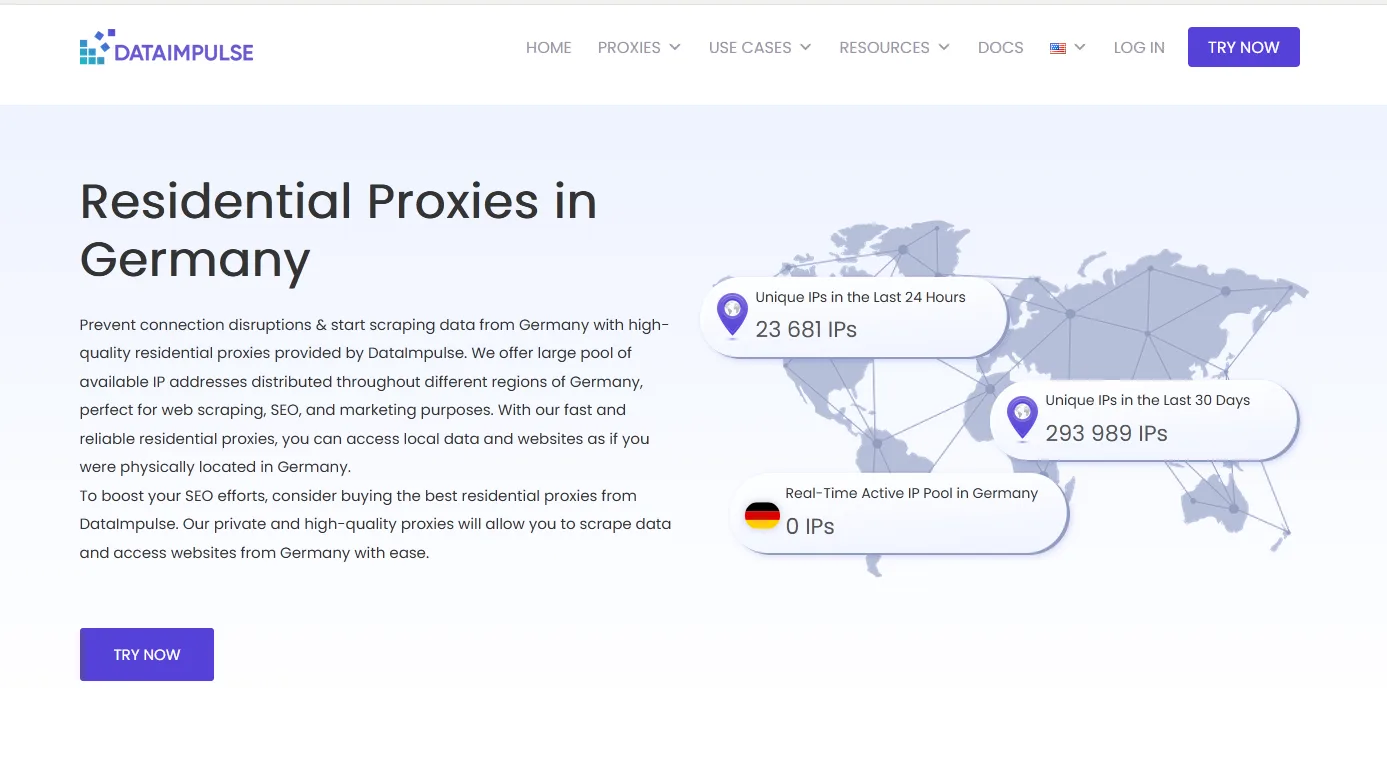
DataImpulse caters to a niche occupied by companies that need large volumes of publicly available German web data but can’t cover Oxylabs’ or Bright Data’s tabs. It’s adequate for keeping an eye on large product catalogs or large-scale search result analysis.
The reason I wrote caveats under ISP and ASN availability has to do with DataImpulse’s pricing structure. You only get access to ISP targeting if you go with premium residential proxies, which cost $5/GB. Meanwhile, DataImpulse treats geo and ASN targeting like advanced features and will charge you double the per-gigabyte price when using them.
Conclusion
Comparing all these German proxy providers just further reinforced a trend that keeps reaffirming itself with each new research project I start. A lavish marketing budget and impressive-sounding claims only get providers so far. Even when their claims prove to be true, a scrappier alternative might be just what you need.
I did my best to remain impartial and cover as many relevant use cases as someone interacting with Germany’s unique digital landscape could need. Hopefully, you will find both the rankings and the unique contributions 1Browser brings to the table useful.