
Top Best Egypt Proxy in 2026

The Egyptian internet market is vibrant and driven by young consumers eager for new trends and ideas. At the same time, strict government measures make establishing oneself technically challenging as an outsider.
Proxy providers are well aware of the demand. If anything, it’s caused them to up the quality of their Egyptian residential and mobile networks. Some focus on clean IPs and rock-solid session stability. Others offer entire data gathering ecosystems.
Meanwhile, tools like 1Browser create the environment necessary for proxies to live up to their promises. Here’s what the best proxy for Egypt ranking looks like in 2026, and why you won’t get very far if you don’t use one.
Why Do You Need an Egypt Web Proxy?
The Egyptian internet is a study in contrasts. On the one hand, Egypt is a populous country with an active young population that has a distinctly mobile-first approach to activities like shopping and socializing. Moreover, Egypt’s Personal Data Protection Law shapes how data on individuals is collected, with an emphasis on consent and transparency.
On the other, Egyptians face more restrictions than people in many other countries. The authorities have gradually expanded powers related to disruptions like throttling certain sites and outright blocking others. The big four Egyptian telecom operators enforce this.
Proxies are crucial for operating in such a restrictive environment. Specifically, they:
- Website testing – The Egyptian internet is heavily localized; prices are displayed in EGP, while text has to be written in Arabic script. Using Egyptian proxies lets outside businesses that operate on the Egyptian market ensure that local audiences see layouts, pricing, ad placement, etc., correctly.
- SEO – A Google search from within Egypt may return different results to an external one. Even local rankings might vary from city to city. Without proxies, it would be impossible to verify this and take steps to improve.
- Market research – Scraping Egyptian websites for pricing information, trends, or competitor analysis is both sensible and time-tested. Residential and mobile proxies provide the legitimate IPs needed to do this without bans and blocks.
- Compliance testing – With the PDPL now being strictly enforced, proxies let businesses operating in Egypt test that their behavior is compliant.
- Censorship and accessibility monitoring – Academics, NGOs, journalists, etc., interested in Egyptian civil liberties need proxies to be able to simulate the genuine Egyptian internet experience. This includes discovering what’s being censored or throttled, and which websites Egyptians may not have access to.
Proxy Selection Criteria
Determining which proxy providers are best-equipped to tackle the unique Egyptian internet landscape was tricky. For example, a provider might offer a high number of IPs, yet most of those could be sourced from datacenters or blocked. That’s why our list is based on a range of criteria, including:
- Size and quality – The number of Egyptian IPs on offer, as well as how many of them are fresh and come from reliable residential or mobile sources.
- Session stability – How sticky sessions and persistent logins are handled. Fewer interrupts mean fewer bans and less verification hassle.
- Geo-targeting precision – Support for granular targeting, including IPs based on cities, ASN, or distinct telecom providers.
- IP reputation – How commonly IPs from the provider trigger CAPTCHAs, fraud detection countermeasures, etc.
- Routing stability – A combination of uptime, latency, and disconnect rates.
- Use cases – Does the provider specialize in a single use case, like scraping, or do they have broad appeal?
- Pricing – How affordable a provider is in general, as well as compared to alternatives vying for the same market segment.
- Ease of use – Can anyone start using Egyptian proxies straight away, or do the UI and any additional tools have a steep learning curve?
Based on these, we’ve selected 10 proxy providers and one invaluable tool to assist them all.
The Best Egypt Web Proxy Picks for 2026
1. 1Browser
Appearing as an actual Egyptian user is non-negotiable if you want to avoid the aggressive triggers and location checks local ecommerce and other sites use. A proxy alone, even if it’s sourced from real Egyptian households or mobile carriers, often won’t be enough to avoid blocks.
1Browser is a web proxy browser in Egypt and its restrictive internet environment doesn’t rattle. Specifically, it lets even inexperienced users quickly set up separate browser instances. Each instance can have its own Egyptian IPs as well as a set of unique hardware and browser fingerprints. This is useful for running Egypt-specific social media accounts alongside standard ones, avoiding overzealous fraud checks, and reducing the mismatch signals that would flag accounts even though they’re used legitimately.
2. Floppydata
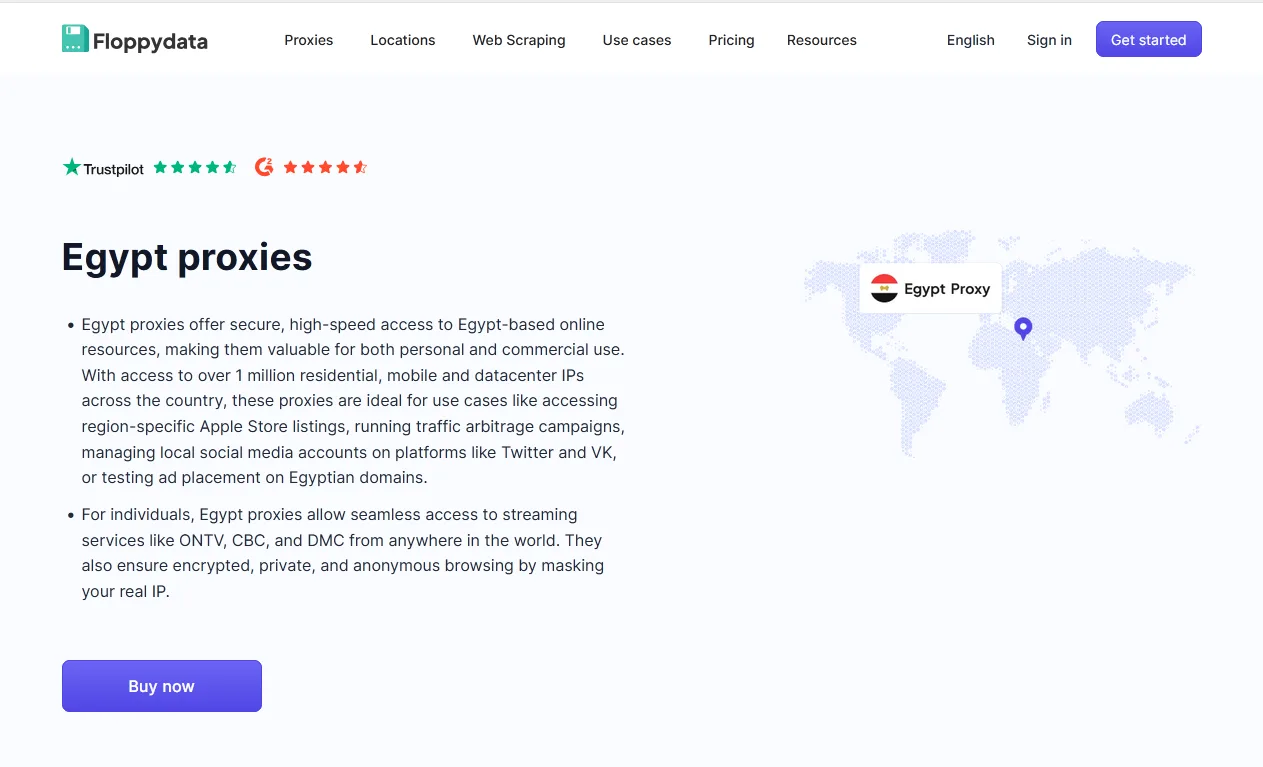
Unless you’re an enterprise-grade client, Floppydata is the best proxy for Egypt out there right now. Everything from affordability to the sensible interface is geared toward individuals and agile businesses who don’t need advanced orchestration and the accompanying price hikes.
Floppydata boasts more than a million Egyptian IPs, including residential and mobile with excellent uptimes and solid CAPTCHA performance. It also has the most attractive pricing structure on the list. Both residential and mobile traffic costs $1/GB on a PAYG basis, Paying a little extra ensures unspent traffic never expires.
3. Bright Data
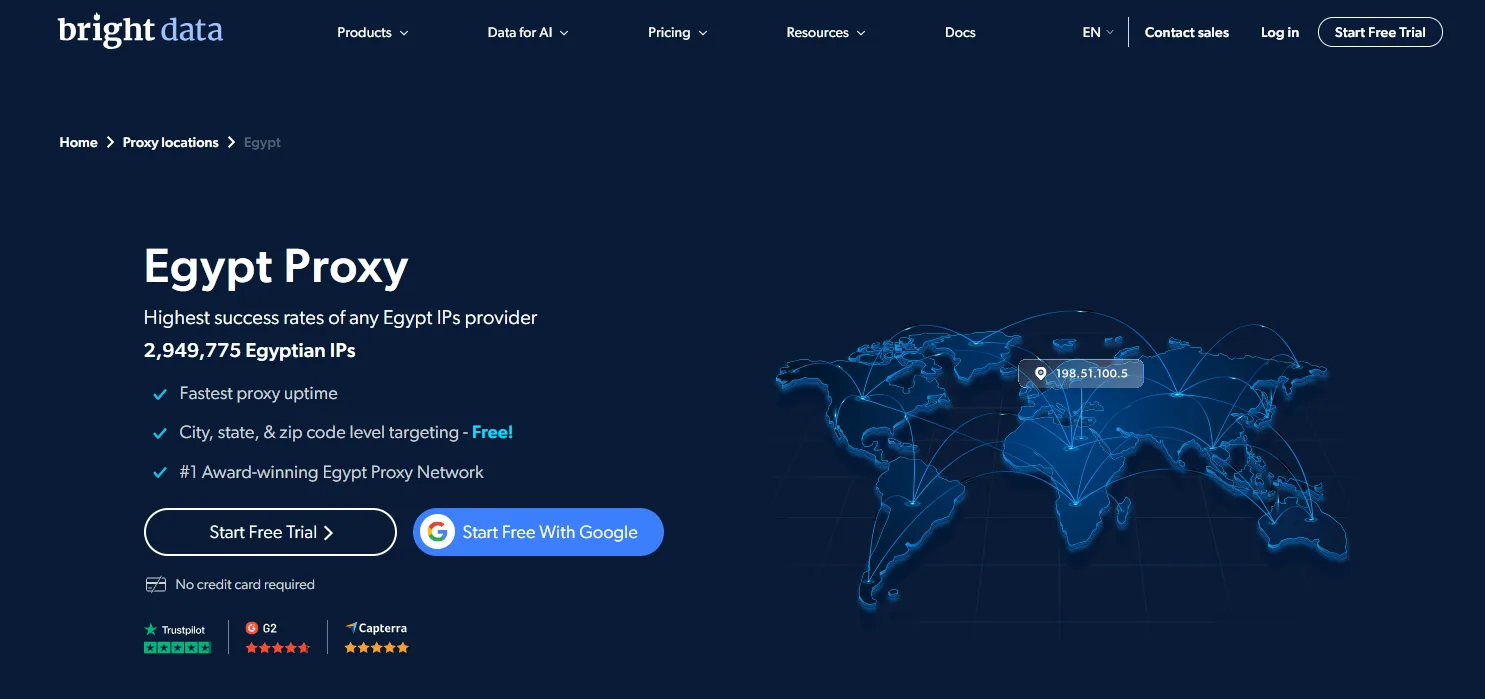
Whereas Floppydata is the go-to for individuals and small to mid-sized businesses, Bright Data has earned a reputation as a top enterprise option. On the one hand, the sheer scale of its almost 3M strong Egypt IP pool means clean IPs and good success rates when handling geo-sensitive tasks.
On the other, Bright Data has grown into an entire ecosystem catering to advanced data collection. Users can pay for structured results rather than scrape sites themselves, for example. Those who do use Bright Data for advanced gathering have to come to grips with the interface. It’s also among the most expensive providers.
4. SOAX
Operations expanding into the Egyptian markets often underestimate the importance of precise targeting. SOAX is high on the list because it’s aware of the power of granularity. It offers precise targeting that distinguishes not just between different cities, but Egyptian mobile providers as well.
SOAX’s dashboard is much less intimidating than Bright Data’s yet doesn’t feel like it compromises functionality for simplicity’s sake. Price-wise, SOAX is somewhere in the middle. You can get the initial $3.60/GB down by a lot if you commit, making SOAX a reasonable option for mid-volume scraping or ad verification. However, the $90/month minimum buy-in may put smaller operations off.
5. Oxylabs
Oxylabs is another enterprise-oriented proxy Egypt presents no trouble for. Rather than focus as much as Bright Data on operational diversity, Oxylabs empowers experienced users with advanced scraping tools. Its IP pool is almost as large, and Oxylabs has an excellent reputation when it comes to routing stability.
In an Egyptian context, this means fewer repeat IPs and more natural request distribution, resulting in fewer triggers. The pricing is comparable to Bright Data’s, and the UI could be more intuitive to attract users who currently lack extensive scraping experience.
6. NetNut
Realism and consistency matter in the Egyptian internet environment. In this context, NetNut’s edge over other, especially smaller competitors, is a focus on direct sourcing. NetNut cooperates with ISPs to secure clean IPs directly through their networks. While it doesn’t disclose the size of its Egyptian IP pool, users note low lag and excellent stability.
This makes NetNut interesting for journalists, activists, and anyone else who needs persistent and fast internet access in the way Egyptians experience it. A forced subscription is the only downside. $99 nets you either 28GB of residential or just 13GB of monthly mobile data.
7. IPRoyal
IPRoyal is a a provider that caters to medium-sized businesses. At around 170,000, its IP pool is among the smallest on the list. However, IPRoyal emphasizes quality and realistic behavior over a sprawling infrastructure, which may or may not be effective. Users praise the reliability of its sticky sessions, which is essential for bot detection bypassing and longer workflows that require persistent IPs.
At first glance, payment flexibility is another plus for IPRoyal. You can buy a single GB of residential proxy traffic, use PAYG, or embrace monthly subs. However, the advertised steep discounts only apply with serious commitments. You can also rent a dedicated mobile IP for $130/month. Steep, but useful for social media managers handling Egyptian client profiles.
8. DataImpulse
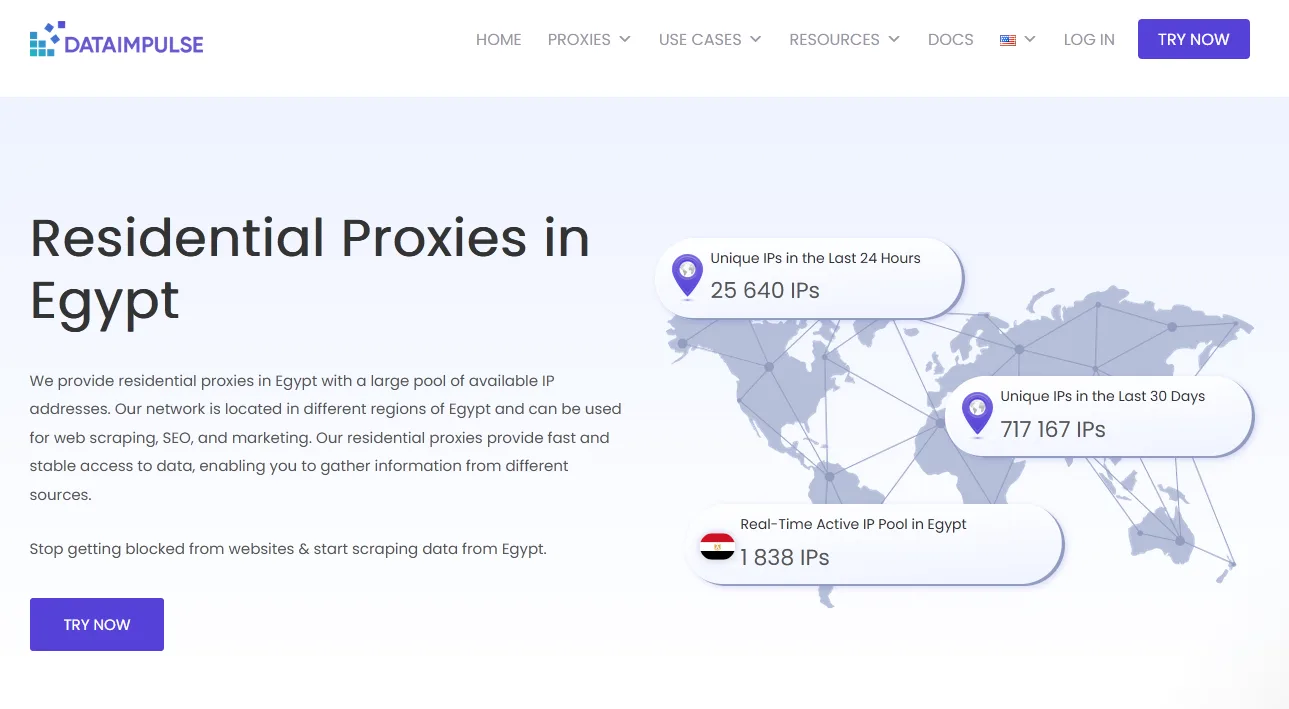
While some providers attract clients with specialized needs, others focus on providing more bang for your buck. DataImpulse sits in the second category due to aggressive pricing and marketing that focuses on broad geo support rather than specialty use cases.
While it doesn’t stand out, DataImpulse doesn’t do anything particularly bad either. It has around 700,000 monthly Egyptian IPs. Neither that nor the touted pricing model compete with FloppyData, though. True, Datacenter traffic costs $1/GB, but the tiers jump from $5 to $50, which individuals with modest needs may dislike. Also, the price doubles for mobile traffic.
9. Infatica
Infatica has a lot in common with IPRoyal. Both strive to provide a balanced experience at reasonable if unimpressive pricing. Less aggressive advertising means Infatica isn’t as well-known as industry staples. Still, diverse IP ranges and above-average success rates make it a viable alternative.
The dashboard is usable and less bloated than the worst offenders, if in need of some polish. PAYG starts steep at $4/GB for residential and $8/GB for mobile IPs but lowers steeply the higher your bandwidth needs. Customer support could be more responsive.
10. Webshare
While most proxies we’ve talked about so far can be used casually, Webshare is the only provider on the list with casual users as its target audience. We’re talking about hobbyists who want to run their first scraping experiments or Egyptians vacationing abroad that want to keep watching their favorite shows on WATCH iT! or Shahid.
Webshare encourages newbies with 1GB of free proxy traffic per month. Afterward, a GB over rotating residential proxies costs $3.50, while committing to ten drops that to $2.75/GB. Webshare doesn’t offer mobile proxies, meaning it’s not adequate for the most detection-sensitive use cases.
11. NodeMaven
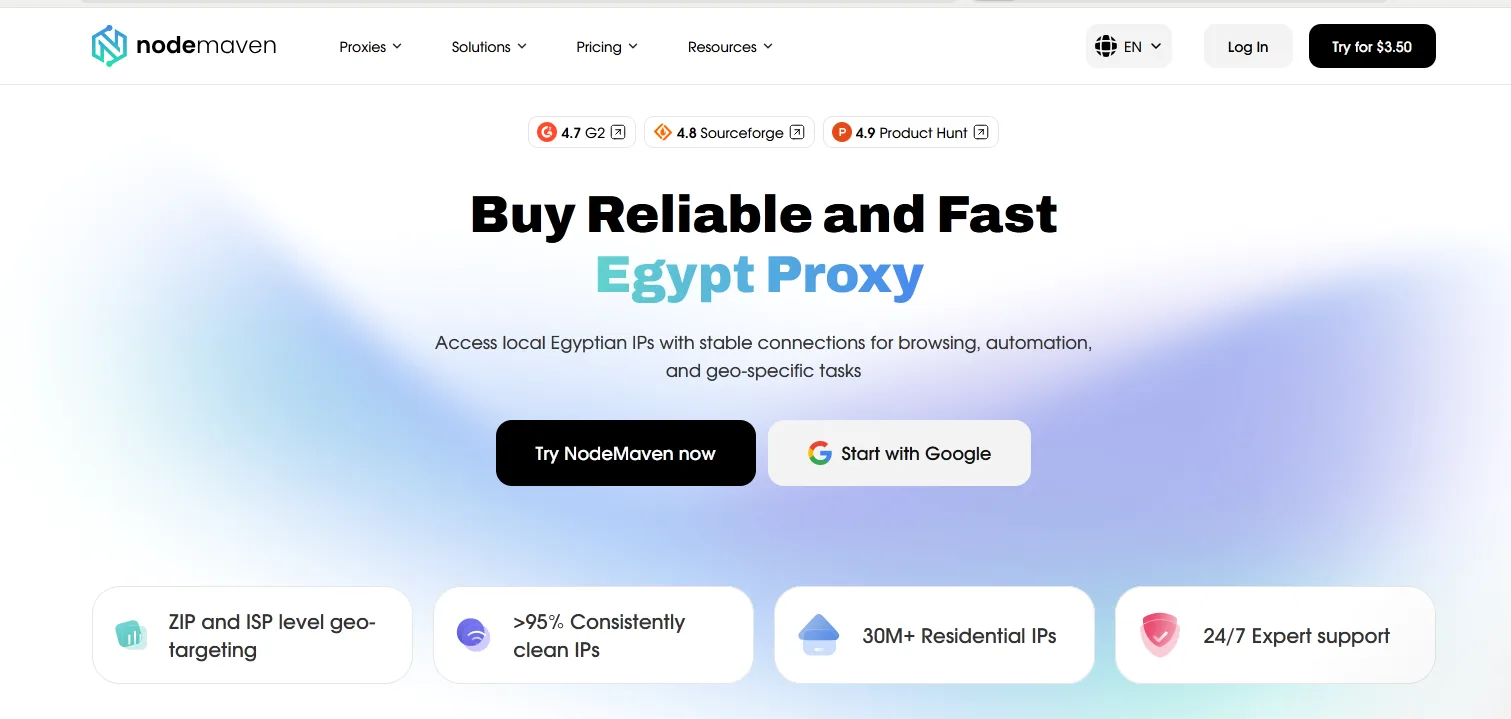
NodeMaven takes the last spot not because it’s bad, but because it has a much smaller presence than the usual suspects. Relative anonymity doesn’t prevent it from being among the proxies Egypt users praise. Specifically, NodeMaven’s curated proxy pool and clean reputation make it a good fit for account-based workflows where consistency and trust matter.
If there’s anything to bicker about, it’s the misleading price structure. NodeMaven says both residential and mobile proxies “start from” $2.20/GB. Actually, this is the bottom price you pay for 1,000GB of monthly data or more. There are more expensive options than the $10 you’ll pay for 2GB if you go the PAYG route. Still, more transparency would be appreciated.
Conclusion
In 2026, generic datacenter proxies and no-name VPNs aren’t viable options for convincingly mimicking Egyptian traffic anymore. Everything matters for seamless access to modern platforms, from IP trustworthiness and session stability to overall connection authenticity. Which specific proxy from our list to go with comes down to whether you’re involved in scraping, ad management, arbitrage, or activism. Either way, using it together with 1Browser will yield the most satisfying results.